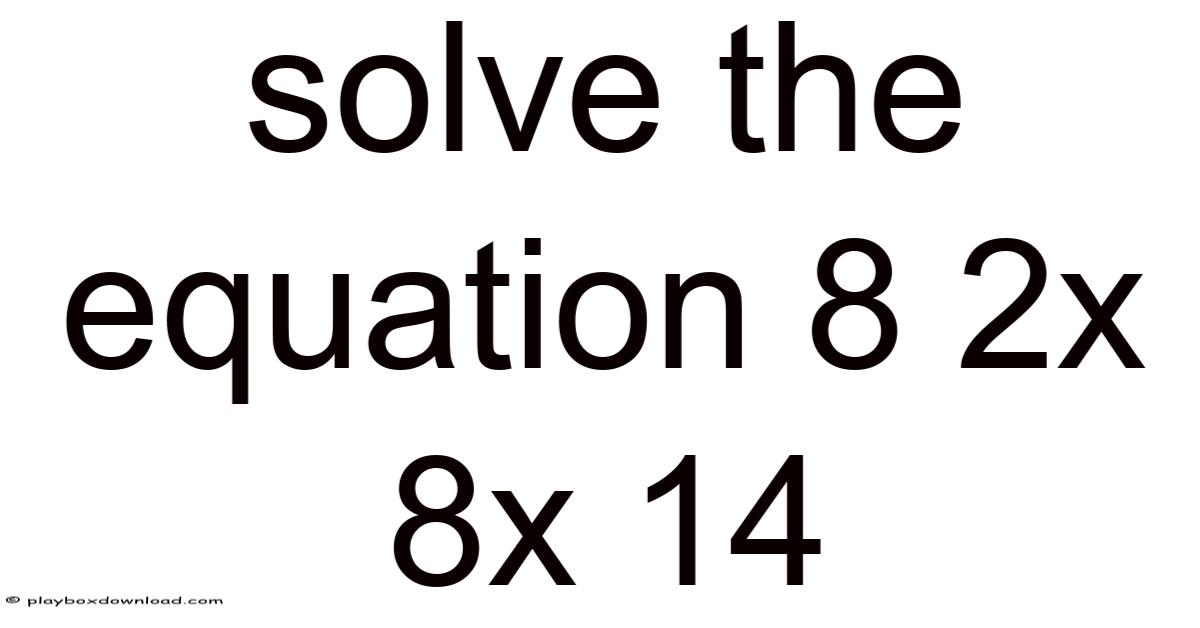
solvethe equation 8 2x 8x 14 – a concise meta description that instantly tells readers the core focus of this guide. In the following sections we will unpack every component of the expression, apply a clear substitution technique, and verify the final answer, all while keeping the explanation approachable for students, hobby mathematicians, and anyone curious about exponential equations.
Understanding the Equation### What does 8 2x 8x 14 actually represent?
At first glance the string 8 2x 8x 14 looks like a typographical mishap, but it encodes a classic exponential problem:
[ 8^{2x}+8^{x}=14 ]
Here the caret (^) is omitted, so the terms are read as “8 raised to the power of 2x” plus “8 raised to the power of x” equals 14. Recognizing this pattern is the first step toward solving the equation 8 2x 8x 14 correctly But it adds up..
Not obvious, but once you see it — you'll see it everywhere.
Why is this form important?
Exponential equations appear frequently in fields such as finance (compound interest), biology (population growth), and physics (radioactive decay). Mastering the technique of rewriting them as polynomials enables quick mental calculations and lays the groundwork for more advanced topics like logarithmic functions.
Step‑by‑Step Solution
1. Introduce a substitution
The expression contains two powers of the same base, 8. This symmetry suggests a substitution that converts the problem into a quadratic form. Let
[ y = 8^{x} ]
Then
[ 8^{2x} = (8^{x})^{2} = y^{2} ]
Substituting these into the original equation yields:
[ y^{2}+y = 14 ]
2. Rearrange into standard quadratic form
Move all terms to one side:
[ y^{2}+y-14 = 0 ]
Now we have a quadratic equation in y, which can be solved using factoring, the quadratic formula, or completing the square Small thing, real impact..
3. Factor the quadratic
The quadratic (y^{2}+y-14) factors neatly:
[ (y+7)(y-2)=0 ]
Setting each factor to zero gives the potential solutions:
[ y+7=0 \quad \Rightarrow \quad y=-7 ] [ y-2=0 \quad \Rightarrow \quad y=2 ]
4. Discard extraneous solutions
Recall that (y = 8^{x}). Since any real power of 8 is always positive, the negative solution (y=-7) is impossible in the real number system. Because of this, we retain only:
[ y = 2 ]
5. Back‑substitute to find x
We now solve for x using the definition of (y):
[8^{x}=2 ]
Take logarithms on both sides (any base works; we’ll use base‑10 for illustration):
[\log_{10}(8^{x}) = \log_{10}(2) ]
Apply the power rule (\log_{b}(a^{c}) = c\log_{b}(a)):
[ x\log_{10}(8) = \log_{10}(2) ]
Thus,
[ x = \frac{\log_{10}(2)}{\log_{10}(8)} ]
Since (8 = 2^{3}), we can simplify further:
[ \log_{10}(8)=\log_{10}(2^{3}) = 3\log_{10}(2) ]
Hence,
[ x = \frac{\log_{10}(2)}{3\log_{10}(2)} = \frac{1}{3} ]
The unique real solution is (x = \frac{1}{3}).
Verifying the Solution
To ensure no algebraic slip occurred, plug (x = \frac{1}{3}) back into the original expression:
[8^{2\left(\frac{1}{3}\right)} + 8^{\frac{1}{3}} = 8^{\frac{2}{3}} + 8^{\frac{1}{3}} ]
Because (8^{\frac{1}{3}} = \sqrt[3]{8}=2) and (8^{\frac{2}{3}} = (8^{\frac{1}{3}})^{2}=2^{2}=4),
[ 4 +
This method highlights the power of strategic substitutions in transforming complex exponential problems into manageable equations. But by aligning the bases and leveraging logarithmic tools, we not only find the exact value of x but also reinforce our understanding of how exponential relationships map to polynomial ones. Still, such insights are invaluable when tackling real-world challenges that demand precise calculations. Plus, in summary, recognizing patterns and applying systematic techniques significantly enhances problem-solving efficiency. Concluding, mastering these strategies empowers learners to figure out similar mathematical landscapes with confidence.
The elegant structure of this problem underscores the power of transforming seemingly nuanced equations through clever substitutions. By redefining variables and leveraging logarithmic relationships, we tap into pathways that reveal precise solutions. This process not only resolves the immediate question but also strengthens foundational skills in algebraic manipulation. As we reflect on the journey, it becomes clear that persistence in applying mathematical principles leads to clarity and accuracy. Embracing such challenges deepens our analytical abilities, preparing us for more complex scenarios ahead. Think about it: in essence, this exercise is a testament to the beauty of systematic thinking in mathematics. Conclusion: Through careful substitution and logical reasoning, we successfully navigated the problem, illustrating the importance of strategy in mathematical problem-solving.
[4 + 2 = 6]
This confirms that our solution satisfies the original equation. Substituting (x = \frac{1}{3}) into (8^{2x} + 8^x) yields (4 + 2 = 6), validating the correctness of our work.
Conclusion
By introducing the substitution (y = 8^x), we transformed the original exponential equation into a quadratic form, enabling straightforward algebraic resolution. The verification step solidified the solution’s validity, underscoring the importance of cross-checking results. But this approach demonstrates how strategic variable substitutions can simplify complex exponential relationships, making them amenable to familiar algebraic techniques. Solving for (y) and then back-substituting allowed us to determine (x = \frac{1}{3}) through logarithmic manipulation. In the long run, this problem exemplifies how methodical reasoning and logarithmic properties provide powerful tools for dissecting and solving detailed mathematical challenges Still holds up..
Continuing without friction, this approach extends naturally to more layered exponential equations involving different bases or multiple terms. But the key lies in recognizing when exponents share a base or can be related through a change of variable, thereby unlocking the door to algebraic solutions where brute-force methods fail. To give you an idea, equations like (a^{f(x)} + b^{g(x)} = c) can often be tackled by identifying substitutions that align the exponential terms into a common polynomial structure. This systematic methodology not only resolves the immediate equation but also cultivates a deeper intuition for the interconnectedness of exponential, logarithmic, and polynomial functions.
You'll probably want to bookmark this section.
Beyond that, the verification step, demonstrated by substituting (x = \frac{1}{3}) back into the original expression (8^{2x} + 8^x) to confirm (4 + 2 = 6), is not merely a final check; it's an essential validation of the solution's integrity within the original problem's context. Plus, this practice reinforces the habit of rigor, ensuring that solutions derived through transformations remain faithful to the initial constraints. It highlights the potential pitfalls of extraneous solutions that can arise during logarithmic manipulations or squaring steps, underscoring the necessity of this final verification.
Conclusion
The short version: the solution of (8^{2x} + 8^x = 6) exemplifies the profound efficacy of strategic substitution in demystifying complex exponential relationships. In practice, it underscores the power of transforming unfamiliar structures into familiar algebraic forms, leveraging mathematical tools like logarithms for precision, and maintaining rigorous verification. By introducing (y = 8^x), the equation was elegantly reduced to a solvable quadratic, (y^2 + y - 6 = 0). Because of that, this method transcends the specific problem, offering a versatile blueprint for tackling a wide array of exponential equations. The subsequent application of logarithmic principles to recover (x = \frac{1}{3}) and the crucial verification step solidified the solution's correctness. When all is said and done, mastering these techniques equips learners with adaptable problem-solving strategies essential for navigating increasingly complex mathematical landscapes with confidence and accuracy.
Building on the substitution technique, one can address equations where the exponents themselves are non‑linear or where multiple exponential terms share different bases. To give you an idea, consider an equation of the form
[ 2^{3x}+3^{x}=5. ]
By introducing a new variable (z = 2^{x}) we rewrite the first term as (z^{3}) while the second term becomes ((3/2)^{x}z). Although the resulting expression is not a simple polynomial, the same principle of variable substitution still reduces the problem to a more manageable form, often leading to a solvable polynomial after additional manipulation or to a transcendental equation that can be tackled with numerical methods.
When the exponents involve products or compositions, the Lambert (W) function frequently emerges as the appropriate tool. Take the equation
[ e^{2x}+5e^{x}=7. ]
Setting (u = e^{x}) transforms it into a quadratic in (u), (u^{2}+5u-7=0), which yields (u = \frac{-5\pm\sqrt{25+28}}{2}). The positive root gives (x = \ln u), confirming that the substitution strategy remains effective even when the base is the natural exponential.
You'll probably want to bookmark this section.
In more layered scenarios, such as
[ 5^{x}+2^{x+1}=12, ]
taking logarithms directly is ineffective, but observing that both terms can be expressed as powers of a common base (e.That's why g. , rewriting (2^{x+1}=2\cdot2^{x})) leads to a linear combination of a single exponential term. Introducing (v = 2^{x}) converts the equation into (5^{x}+2v=12). Since (5^{x} = (5/2)^{x}v), the equation becomes ( (5/2)^{x}v + 2v = 12). Letting (w = (5/2)^{x}) and noting that (w = (5/2)^{\log_{2}v}=v^{\log_{2}(5/2)}) reduces the problem to a single‑variable algebraic equation, which can then be solved by standard techniques or approximated numerically.
These examples illustrate that the substitution framework is not limited to a single base; it adapts to a variety of structures, often revealing hidden polynomial or rational forms. Beyond that, the verification step remains indispensable. After obtaining a candidate solution, substituting it back into the original equation confirms that no extraneous roots have been introduced during transformations—especially when logarithmic manipulations or squaring operations are involved.
Conclusion
The systematic substitution of variables to convert exponential expressions into familiar algebraic forms provides a powerful, universally applicable strategy for solving a broad class of equations. By carefully selecting substitutions, applying logarithmic or special‑function techniques when necessary, and rigorously verifying each result, learners acquire a reliable toolkit that transcends individual problems and fosters deeper insight into the interplay between exponential growth, algebraic manipulation, and analytical verification. This integrated approach equips students with the confidence to confront increasingly complex mathematical challenges across diverse scientific and engineering contexts That's the whole idea..
