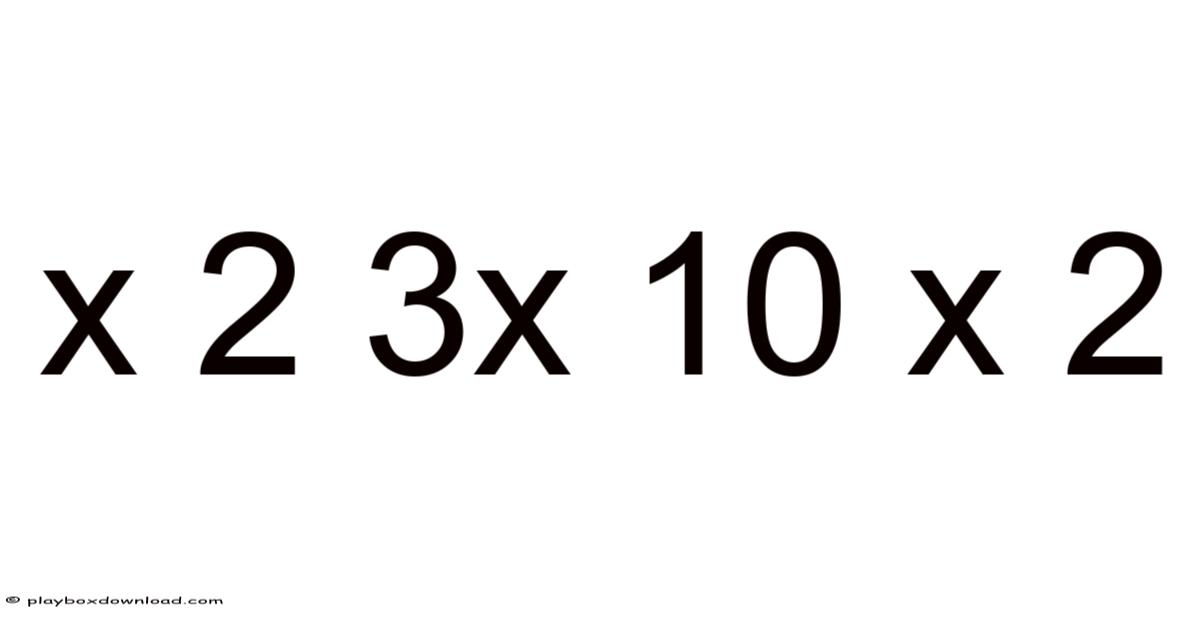
Expanding the Expression (x²)(3x + 10)(x + 2): A Step-by-Step Guide
Expanding algebraic expressions is a foundational skill in mathematics that helps simplify complex problems and understand polynomial behavior. In real terms, one such expression that often confuses students is (x²)(3x + 10)(x + 2). This article will walk you through the process of expanding this expression, explain the underlying principles, and provide answers to common questions to solidify your understanding Surprisingly effective..
This changes depending on context. Keep that in mind.
Introduction to the Expression
The expression (x²)(3x + 10)(x + 2) consists of three terms multiplied together:
- x² (a quadratic term)
- (3x + 10) (a linear binomial)
To expand this expression, we need to apply the distributive property repeatedly, which states that a(b + c) = ab + ac. This process involves multiplying each term in the first polynomial by every term in the subsequent polynomials and then combining like terms.
Steps to Expand the Expression
Step 1: Multiply the First Two Terms
Start by multiplying x² with (3x + 10):
[
x² \cdot (3x + 10) = x² \cdot 3x + x² \cdot 10 = 3x³ + 10x²
]
Here, we apply the rule of exponents: xᵃ · xᵇ = xᵃ⁺ᵇ. Here's one way to look at it: x² · x = x³ Less friction, more output..
Step 2: Multiply the Result by the Third Term
Now, take the result (3x³ + 10x²) and multiply it by (x + 2):
[
(3x³ + 10x²) \cdot (x + 2) = 3x³ \cdot x + 3x³ \cdot 2 + 10x² \cdot x + 10x² \cdot 2
]
Breaking this down:
- First term: 3x³ · x = 3x⁴
- Second term: 3x³ · 2 = 6x³
- Third term: 10x² · x = 10x³
- Fourth term: 10x² · 2 = 20x²
Step 3: Combine Like Terms
Add all the terms together:
[
3x⁴ + 6x³ + 10x³ + 20x²
]
Combine the x³ terms:
[
6x³ + 10x³ = 16x³
]
The final expanded form is:
[
3x⁴ + 16x³ + 20x²
]
Scientific Explanation of the Result
The expanded expression 3x⁴ + 16x³ + 20x² is a polynomial of degree 4 (quartic). Here’s why:
- The leading term is 3x⁴, which determines the polynomial’s degree.
- The coefficients (3, 16, 20) represent the combined contributions of each multiplication step.
- The absence of an x or constant term indicates that all terms contain at least x² as a factor.
This
polynomial represents the cumulative effect of scaling and combining the original factors. Each term's coefficient reflects the multiplicative interactions between the constants in the original expression: 3 from the 3x term, 10 from the constant in the first binomial, and 2 from the constant in the second binomial.
Graphical Interpretation and Behavior
Understanding the expanded form becomes more meaningful when we visualize it. The function f(x) = 3x⁴ + 16x³ + 20x² exhibits specific characteristics:
- As x approaches positive or negative infinity, the 3x⁴ term dominates, causing the graph to rise toward positive infinity on both ends
- The function intersects the y-axis at the origin since there's no constant term
- The x-intercepts occur where the function equals zero, which corresponds to the solutions of x²(3x + 10)(x + 2) = 0
Real-World Applications
This type of expansion appears frequently in various fields:
- Engineering: Calculating volumes or stress distributions where multiple variables interact multiplicatively
- Economics: Modeling revenue functions where price, demand, and market factors combine
- Physics: Describing motion or energy relationships involving multiple interacting forces
Verification and Common Mistakes
To verify our expansion is correct, we can substitute a test value. Let's use x = 1:
- Original expression: (1)²(3(1) + 10)(1 + 2) = 1 × 13 × 3 = 39
- Expanded form: 3(1)⁴ + 16(1)³ + 20(1)² = 3 + 16 + 20 = 39 ✓
Common errors include:
- Forgetting to distribute to all terms
- Incorrectly applying exponent rules
- Failing to combine like terms properly
Conclusion
Expanding (x²)(3x + 10)(x + 2) systematically demonstrates the power of algebraic manipulation. So this quartic polynomial not only represents a mathematical relationship but also serves as a foundation for solving more complex equations, analyzing function behavior, and modeling real-world phenomena. By applying the distributive property methodically—first multiplying x² with (3x + 10), then distributing that result with (x + 2)—we arrive at the simplified form 3x⁴ + 16x³ + 20x². Mastering this expansion technique builds essential skills for advanced mathematics and practical problem-solving across numerous disciplines That's the part that actually makes a difference..
Further Analysis: Solving and Factoring
The expanded form 3x⁴ + 16x³ + 20x² is particularly useful for solving the equation x²(3x + 10)(x + 2) = 0. Setting the polynomial equal to zero yields:
- x² = 0 → x = 0 (with multiplicity 2)
- 3x + 10 = 0 → x = -10/3 (approximately -3.33)
- x + 2 = 0 → x = -2
Some disagree here. Fair enough Turns out it matters..
This reveals three distinct x-intercepts at x = 0, x = -2, and x = -10/3. The double root at x = 0 (due to the x² factor) means the graph touches the x-axis at the origin and turns around, rather than crossing it sharply, consistent with the even power.
Factoring the expanded polynomial back to its original form, x²(3x + 10)(x + 2), demonstrates the reversibility of the process and confirms the roots' origins. The factor x² explicitly shows the root at zero has multiplicity two No workaround needed..
Implications for Calculus and Beyond
Understanding this expansion is crucial for higher-level mathematics. Also, setting this to zero helps locate critical points (maxima, minima, points of inflection) on the original function's graph. * Integration: The expanded form is straightforward to integrate: ∫(3x⁴ + 16x³ + 20x²) dx = (3/5)x⁵ + 4x⁴ + (20/3)x³ + C, which could represent accumulated area or other quantities in applied contexts. That's why for instance:
- Derivatives: Finding the derivative of f(x) = 3x⁴ + 16x³ + 20x² yields f'(x) = 12x³ + 48x² + 40x = 4x(3x² + 12x + 10). * Polynomial Long Division: This expanded polynomial could be the dividend or divisor in more complex rational function operations.
Conclusion
The expansion of (x²)(3x + 10)(x + 2) into 3x⁴ + 16x³ + 20x² exemplifies the power and necessity of algebraic manipulation. On top of that, it serves as the critical foundation for solving equations, calculating derivatives and integrals, and tackling more complex algebraic operations in calculus and advanced mathematics. By systematically applying the distributive property, we transform a product of factors into a sum of terms, revealing the polynomial's structure and behavior. Because of that, this expanded form provides immediate access to key features like end behavior, intercepts, and multiplicity, which are essential for graphing and analysis. Mastering such expansions is not merely an exercise in symbol manipulation; it builds the analytical toolkit necessary for interpreting mathematical models, solving real-world problems, and progressing to higher levels of mathematical understanding.
The ability toexpand and factor polynomials like this is not just a mathematical exercise; it reflects a deeper understanding of how algebraic structures interact. In real-world applications, such as physics or engineering, recognizing patterns in equations can simplify complex problems. As an example, modeling the trajectory of an object might involve a polynomial equation where identifying roots or critical points through expansion and factoring becomes essential. Similarly, in economics, polynomial functions can represent cost or revenue models, where solving for optimal points requires the same analytical tools Easy to understand, harder to ignore..
This process also underscores the importance of algebraic fluency in computational fields. With the rise of symbolic computation software, the manual expansion of polynomials might seem less critical, but it remains foundational. And understanding the underlying principles allows users to interpret and verify results from algorithms, ensuring accuracy in automated systems. Worth adding, as mathematics evolves, the ability to manipulate and analyze expressions like 3x⁴ + 16x³ + 20x² will continue to be relevant in emerging areas such as machine learning, where polynomial features often play a role in data modeling.
Counterintuitive, but true.
To keep it short, the expansion of (x²)(3x + 10)(x + 2) into its standard form is a gateway to deeper mathematical insight. But it connects basic algebraic rules to advanced concepts in calculus, analysis, and applied sciences. By mastering these techniques, students and professionals alike gain not only problem-solving skills but also a framework for thinking critically about the relationships between mathematical expressions. This knowledge, while rooted in tradition, remains indispensable in navigating the complexities of modern mathematics and its applications Practical, not theoretical..
