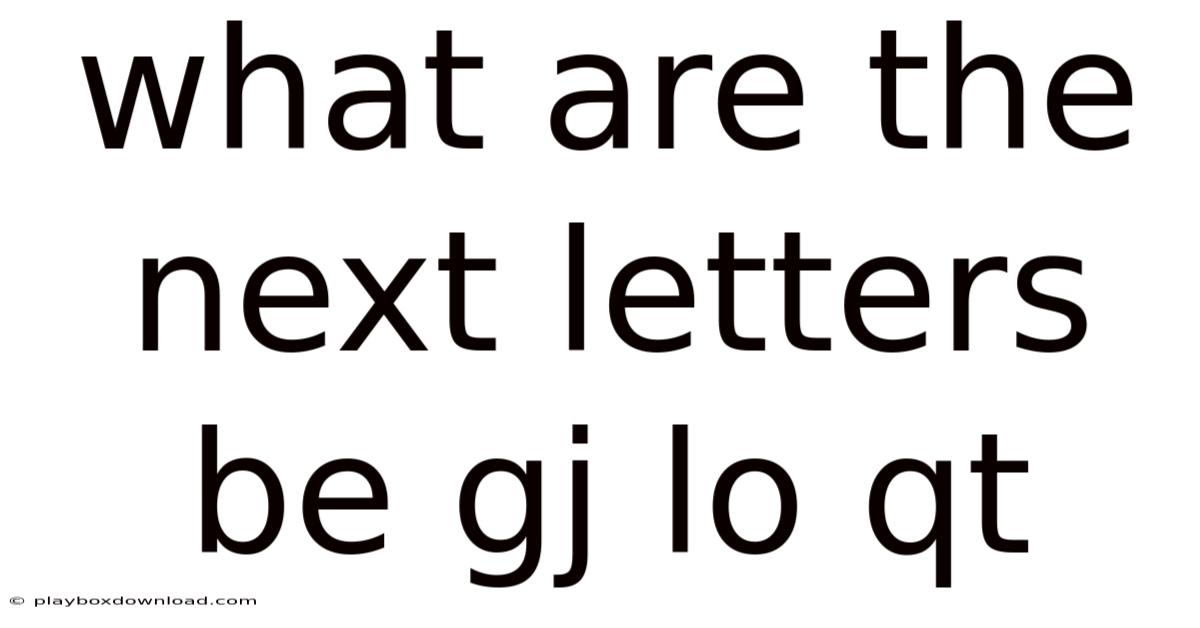
In the world of patterns and sequences, the ability to identify the next element is a skill that sharpens logical thinking and boosts problem-solving abilities. One such intriguing sequence is the set of letters: g, j, l, o, q, t. Worth adding: at first glance, these letters may seem random, but a closer look reveals a deliberate and clever pattern. This article will explore the logic behind this sequence and determine what the next letters will be, offering insights into the fascinating world of pattern recognition.
Counterintuitive, but true.
Understanding the Sequence
To solve the puzzle of the next letters in the sequence g, j, l, o, q, t, it's essential to first examine the position of each letter in the English alphabet. By assigning each letter its corresponding numerical position, we can uncover the hidden pattern:
- g is the 7th letter
- j is the 10th letter
- l is the 12th letter
- o is the 15th letter
- q is the 17th letter
- t is the 20th letter
By analyzing these positions, a clear pattern emerges. The sequence is not based on a simple arithmetic progression but rather on a more complex set of intervals. Let's break down the differences between each letter's position:
- From g (7) to j (10): +3
- From j (10) to l (12): +2
- From l (12) to o (15): +3
- From o (15) to q (17): +2
- From q (17) to t (20): +3
The pattern alternates between adding 3 and adding 2 to the position of the previous letter. This alternating sequence of +3 and +2 is the key to predicting the next letters Surprisingly effective..
Predicting the Next Letters
Now that we've identified the pattern, we can confidently predict the next letters in the sequence. Following the established rule, the next step after t (20) would be to add 2, resulting in the 22nd letter of the alphabet, which is v. Continuing the pattern, the next addition would be +3, bringing us to the 25th letter, y.
That's why, the next letters in the sequence g, j, l, o, q, t are v and y. This logical progression not only solves the puzzle but also demonstrates the power of pattern recognition in understanding and predicting sequences And it works..
The Importance of Pattern Recognition
Pattern recognition is a fundamental skill that extends far beyond solving letter sequences. Plus, it makes a real difference in various fields, including mathematics, science, and even everyday decision-making. By identifying patterns, we can make predictions, solve problems, and gain deeper insights into the world around us.
In education, teaching students to recognize and analyze patterns helps develop critical thinking and analytical skills. It encourages them to look beyond the surface and explore the underlying structures that govern sequences and relationships. This skill is particularly valuable in subjects like mathematics, where understanding patterns is essential for solving equations and understanding complex concepts.
Honestly, this part trips people up more than it should.
Also worth noting, pattern recognition is not limited to academic pursuits. It is a skill that is widely applicable in real-life situations, from recognizing trends in data to making informed decisions based on past experiences. By honing this ability, individuals can enhance their problem-solving capabilities and approach challenges with a more strategic mindset Worth keeping that in mind..
Conclusion
The sequence g, j, l, o, q, t may have seemed like a random assortment of letters at first, but a closer examination reveals a clever and deliberate pattern. That said, by understanding the alternating sequence of +3 and +2, we can confidently predict that the next letters are v and y. This exercise in pattern recognition not only solves the puzzle but also highlights the importance of this skill in various aspects of life And that's really what it comes down to..
As we continue to encounter sequences and patterns in our daily lives, the ability to recognize and analyze them becomes increasingly valuable. Because of that, whether in academics, professional settings, or personal endeavors, pattern recognition empowers us to make sense of the world and deal with it with greater confidence and clarity. So, the next time you come across a sequence, take a moment to look for the pattern—it might just lead you to the answer you're seeking Worth keeping that in mind. Less friction, more output..
The sequence g, j, l, o, q, t serves as a reminder that even seemingly random arrangements often follow an underlying logic. By carefully analyzing the pattern—alternating between adding 3 and adding 2 to the alphabetical position of each letter—we arrive at the next letters: v and y. This process not only solves the puzzle but also underscores the broader significance of pattern recognition in problem-solving and decision-making Worth knowing..
Pattern recognition is a skill that transcends academic exercises, finding applications in fields like data analysis, strategic planning, and even creative endeavors. In practice, it trains the mind to identify relationships, predict outcomes, and approach challenges with a structured mindset. Whether deciphering a sequence, interpreting trends, or making informed choices, the ability to recognize patterns equips us with a powerful tool for navigating complexity Simple, but easy to overlook..
At the end of the day, the sequence g, j, l, o, q, t is more than just a puzzle—it’s an invitation to engage with the world analytically. By honing our pattern recognition skills, we not only solve immediate challenges but also cultivate a mindset that fosters curiosity, critical thinking, and adaptability. So, the next time you encounter a sequence or a pattern, embrace the opportunity to explore its logic—you might just uncover a deeper understanding of the world around you Simple as that..
Building on thisinsight, the same principle can be applied to far more complex systems. In cryptography, for instance, analysts often rely on subtle shifts in character codes to crack ciphers, while musicians exploit patterns of intervals to craft memorable melodies. Even in everyday decision‑making—whether evaluating investment options or planning a travel itinerary—recognizing the incremental steps that lead from one state to another can reveal hidden efficiencies or pitfalls Worth knowing..
Consider a practical scenario: a project manager tracking milestones might notice that deliverables tend to advance by roughly 15 % of the remaining work each week, then plateau before a final push. By mapping this rhythm onto a simple arithmetic progression, the manager can forecast completion dates with greater accuracy, allocate resources proactively, and mitigate the risk of bottlenecks. Such analytical foresight transforms abstract patterns into actionable strategies.
The broader lesson is that pattern recognition is not an isolated skill but a gateway to systematic thinking. When we train ourselves to dissect sequences, we simultaneously sharpen our ability to spot trends in data sets, anticipate behavioral cycles, and design solid solutions across disciplines. This cultivated mindset encourages curiosity, reduces reliance on guesswork, and fosters a proactive stance toward uncertainty.
Short version: it depends. Long version — keep reading.
In the long run, the exercise of tracing letters through incremental steps serves as a microcosm of a larger cognitive toolkit. By internalizing the methodical approach demonstrated here, we equip ourselves to figure out increasingly layered challenges with confidence and clarity. In embracing this analytical lens, we not only decode puzzles but also empower our capacity to shape the future with informed, strategic insight Turns out it matters..
The ripple effects of this analytical mindset extend into the realm of technology and artificial intelligence, where pattern recognition forms the backbone of machine learning algorithms. Worth adding: by understanding how humans dissect sequences and infer rules, we gain insight into the very mechanisms that enable machines to learn. That said, these systems thrive on identifying recurring structures within vast datasets, from detecting fraudulent transactions to diagnosing medical conditions. Yet, this also underscores a uniquely human advantage: our capacity for abstract reasoning, intuition, and creativity when faced with novel or ambiguous patterns that defy simple algorithmic solutions.
Short version: it depends. Long version — keep reading.
In education, cultivating pattern recognition transforms learners into active seekers of knowledge rather than passive recipients. Practically speaking, when students learn to identify relationships between mathematical concepts, historical events, or scientific phenomena, they build interconnected mental frameworks that enhance retention and transfer. Teachers who highlight these connections empower learners to ask deeper questions, anticipate outcomes, and approach unfamiliar problems with confidence. This pedagogical shift from rote memorization to relational thinking prepares individuals for a world where adaptability outweighs static expertise And that's really what it comes down to. Worth knowing..
On a societal level, pattern recognition informs public policy, urban planning, and environmental stewardship. Practically speaking, epidemiologists track disease trajectories by recognizing patterns in transmission data; economists forecast market shifts by analyzing cyclical behaviors; and climate scientists identify long-term trends by examining historical weather data. Each of these applications demonstrates how collective analytical efforts can mitigate risks, allocate resources efficiently, and shape resilient strategies for the future.
The bottom line: the journey from a simple letter sequence to complex system analysis mirrors the broader arc of human cognition. By nurturing our innate ability to perceive order within chaos, we reach pathways to innovation, empathy, and progress. Pattern recognition reminds us that beneath the apparent randomness of life lies structure waiting to be discovered—an invitation to engage, question, and grow. As we continue to refine this skill, we not only solve the puzzles before us but also build the foundation for a more thoughtful, prepared, and empowered generation ready to shape tomorrow's possibilities.
