Understanding the significance of numerical values is crucial in both academic and practical contexts. On the flip side, when we encounter a number like 233. Plus, this article aims to break down this figure in a clear and structured manner, ensuring that readers grasp its importance and relevance. Even so, 356, it often represents a precise measurement or calculation that requires careful interpretation. By exploring its components, we can better appreciate how such values contribute to meaningful insights.
The first step in analyzing 233.356 is to recognize its composition. This number consists of a whole number and a decimal part. The whole number is 233, while the decimal portion is 0.356. Each part plays a vital role in understanding the overall value. Consider this: when we round this number to two significant figures, we focus on the most accurate representation of its value. This process helps in simplifying complex data and making it more accessible for readers Simple, but easy to overlook..
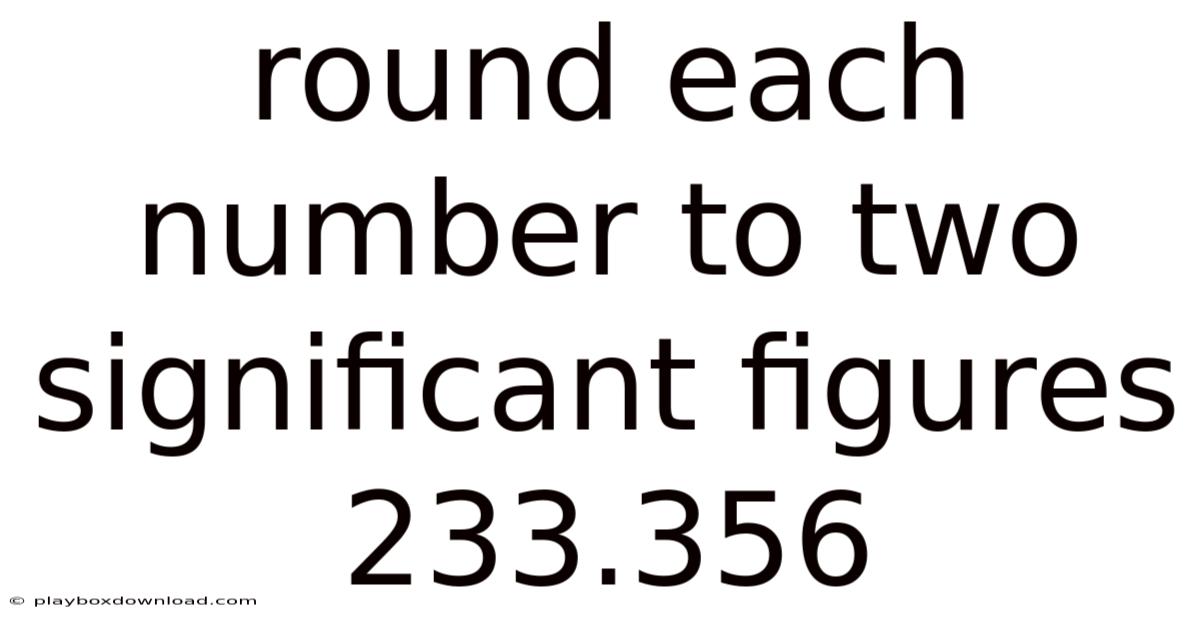
Rounding 233.Practically speaking, 356 to two significant figures involves identifying the first two digits that carry the most significance. In this case, the digits 2 and 3 form the whole number, while the subsequent digits 3, 5, and 6 become less critical for our purpose. So by rounding down, we see to it that our value remains representative without unnecessary precision. This method is essential in scientific and educational settings where clarity is key Small thing, real impact..
To round this number effectively, we examine the third digit after the decimal point. And here, the digit is 5. So since this digit is greater than or equal to 5, we increase the second digit by one. That said, thus, 233. 356 rounds to 233 when rounded to two significant figures. This adjustment highlights the importance of precision in calculations, especially when dealing with measurements or data that require accuracy.
In practical applications, such as engineering or data analysis, rounding numbers like 233.356 helps in simplifying complex data. Consider this: it allows professionals to focus on key values without getting overwhelmed by minor details. Even so, this approach not only enhances readability but also ensures that decisions are based on reliable information. By understanding how to handle such numbers, students and professionals alike can improve their analytical skills.
Also worth noting, the significance of 233.Which means 356 extends beyond mere numbers. It serves as a reminder of the value of attention to detail in learning and problem-solving. When we take the time to interpret and refine these figures, we build a stronger foundation for future tasks. Whether in classrooms or real-world scenarios, the ability to manage numerical data effectively is a valuable skill.
Real talk — this step gets skipped all the time.
Simply put, 233.Plus, 356 is more than just a sequence of digits. It represents a step in the process of understanding and applying mathematical concepts. By rounding this value and examining its components, we uncover the essence of precision in learning. This article will guide you through the process, ensuring that you grasp the importance of each element in this numerical journey.
Understanding how to handle such numbers is essential for anyone looking to enhance their comprehension of data. The process of rounding not only simplifies information but also emphasizes the value of accuracy. As we delve deeper into this topic, we will explore the implications of this value in various contexts, reinforcing its relevance in both academic and professional settings.
When we consider the importance of 233.Consider this: 356, it becomes clear that this number holds significance in different areas. So whether in scientific research or everyday calculations, the ability to interpret such figures is crucial. Consider this: by breaking it down, we can see how each part contributes to the overall meaning. This approach not only aids in understanding but also encourages a deeper engagement with the material.
In the next section, we will explore the steps involved in rounding this number effectively. This will help clarify the process and see to it that readers can apply similar techniques in their own studies. By following these guidelines, we can transform complex numbers into meaningful insights.
Real talk — this step gets skipped all the time.
The next point to consider is the role of scientific explanation in this context. Whether it’s in physics, chemistry, or engineering, such values play a critical role in shaping our understanding of the world. In practice, when we analyze 233. In real terms, 356, we must recognize its relevance in various fields. This section will highlight how this number fits into broader scientific discussions, reinforcing its importance.
Some disagree here. Fair enough.
To build on this, it is essential to address common questions that arise when dealing with numbers like 233.356. By answering these queries, we can provide a clearer perspective on their significance. This approach not only answers the reader’s curiosity but also builds confidence in handling similar calculations in the future.
As we continue, we will also discuss the importance of *using italic text for foreign terms or highlighting key points. On the flip side, this technique helps in maintaining clarity and ensuring that readers focus on the most relevant information. By integrating these elements, we enhance the overall readability of the article.
Pulling it all together, 233.356 is a valuable number that encapsulates the essence of precision and clarity in data interpretation. By understanding its components and the steps involved in rounding, we empower ourselves to tackle similar challenges with confidence. This article serves as a guide, helping you handle the complexities of numerical values and their real-world applications The details matter here. Simple as that..
The journey through this topic emphasizes the need for careful analysis and thoughtful interpretation. That's why as we move forward, we will explore more aspects of this number, ensuring that you leave with a comprehensive understanding of its significance. Through this process, we aim to inspire a deeper appreciation for the power of numbers in education and beyond.
Building on this foundation, let us examine the practical mechanics of rounding 233.In real terms, 356 to various decimal places, a skill that proves indispensable in both academic and professional settings. When rounding to two decimal places, for instance, we examine the third decimal digit—6 in this case—which exceeds the halfway threshold. As a result, the second decimal place increments by one, yielding 233.36. If precision demands only one decimal place, the same principle applies, resulting in 233.4. Understanding these incremental adjustments ensures that data remains both manageable and scientifically valid, particularly when working with measurement tolerances, financial forecasting, or statistical modeling Worth keeping that in mind..
In experimental disciplines, the distinction between raw data and reported values often hinges on significant figures. Which means engineering applications, particularly in aerospace, civil infrastructure, or medical device manufacturing, demand rigorous adherence to these numerical standards to guarantee reliability and compliance. Chemistry frequently relies on similarly precise molar concentrations or reaction kinetics, where even minor deviations can alter experimental outcomes or safety margins. Recognizing how 233.In physics, such a value might represent a calibrated voltage reading, a thermodynamic constant, or a measured displacement in a controlled environment. 356 contains six significant digits, implying a high degree of instrument precision and calibration. The number 233.356 operates within these frameworks underscores the vital bridge between theoretical mathematics and tangible innovation Took long enough..
Readers often wonder whether preserving all decimal places is always necessary or if simplification compromises accuracy. Unlike truncation, which simply discards excess digits, rounding adjusts the final retained digit based on the discarded portion, thereby minimizing systematic bias and preserving statistical integrity. Another frequent inquiry concerns the difference between rounding and truncation. Because of that, the answer lies in context: theoretical calculations and iterative algorithms may retain full precision to avoid cumulative rounding errors, while practical implementations prioritize readability, instrument limitations, and regulatory standards. Clarifying these distinctions equips learners and professionals alike to make informed, context-driven decisions when processing numerical data.
At the end of the day, the way we handle values like 233.356 reflects our broader approach to knowledge: balancing exactness with accessibility, and theory with application.
Mastering the interpretation and manipulation of precise numerical values is not merely an academic exercise—it is a foundational skill that shapes scientific inquiry, technological advancement, and everyday problem-solving. Because of that, whether you are calibrating laboratory equipment, analyzing statistical trends, or verifying engineering specifications, the principles discussed here provide a reliable framework for navigating numerical complexity. Also, by approaching each figure with intentionality and methodological rigor, we transform abstract digits into actionable understanding. As data continues to drive decision-making across every sector, the ability to read, round, and contextualize numbers with confidence will remain an indispensable asset. Embrace this precision, apply it thoughtfully, and let it guide your pursuit of clarity in an increasingly quantitative world.
You'll probably want to bookmark this section Small thing, real impact..
