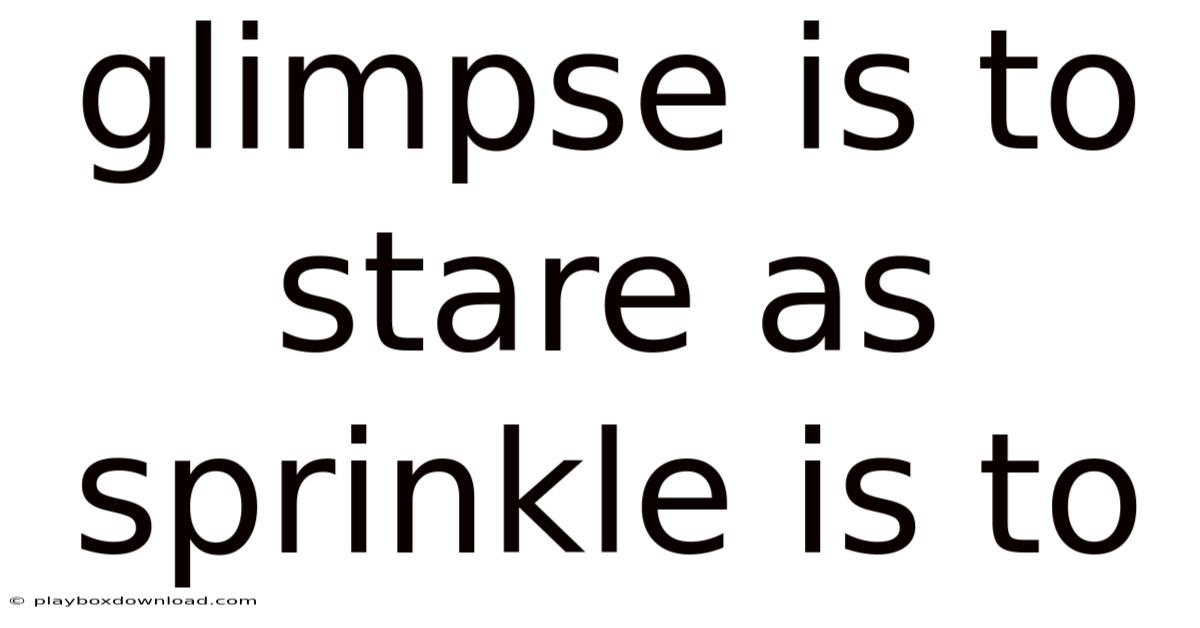
A glimpse and a stare illustrate a fundamental contrast between brevity and duration, just as a sprinkle and a shower reveal a similar shift from light to heavy. This analogy—glimpse is to stare as sprinkle is to shower—captures how a modest, fleeting action can evolve into a more intense, sustained one. By unpacking the relationship, we can better appreciate everyday language, improve communication, and even sharpen our observational skills.
Understanding the Core Relationship
Brief vs. Prolonged
-
Glimpse: a quick, momentary look; the viewer registers only a fragment of the scene.
-
Stare: an extended, often deliberate focus; the eyes linger, absorbing details.
-
Sprinkle: a light, scattered fall of water; it touches the ground for a short time and with minimal intensity.
-
Shower: a more continuous, heavier rain; droplets persist longer and cover a larger area.
The pattern is clear: the first term denotes a limited occurrence, while the second term represents an expanded version of the same phenomenon. Recognizing this pattern helps writers choose the right word for the desired emphasis.
Semantic Fields at Play
- Visual perception: glimpse → stare (short glance → prolonged gaze).
- Meteorology: sprinkle → shower (light drizzle → moderate to heavy rain).
Both pairs share a semantic link based on intensity and duration. This parallel makes the analogy especially powerful for educational contexts, where students learn to map familiar concepts onto new ones.
How the Analogy Works in Practice
1. Identifying the Base Concept
When you encounter a word like glimpse, ask yourself: What is the core idea? In this case, it is a short, limited visual experience.
2. Finding the Counterpart
Next, locate a word that amplifies both duration and intensity. For glimpse, that counterpart is stare.
3. Applying the Same Logic to a New Pair
Take sprinkle—a light, brief rain. Following the same logic, the amplified version is shower, which denotes a longer, more substantial rain event.
4. Using the Analogy in Writing - Original sentence: “She caught a glimpse of the sunrise.”
-
Expanded version: “She watched the sunrise for hours, staring at the horizon.”
-
Original sentence: “A light sprinkle fell on the patio.”
-
Expanded version: “A steady shower drenched the patio throughout the afternoon.”
By swapping the base term with its intensified counterpart, you instantly convey a shift in scale.
Real‑World Examples
Visual Observations
- Glimpse of a comet vs. stare at a comet
- Brief flash of lightning vs. stare at a lightning storm
Weather Descriptions
- A sprinkle of rain vs. a sudden shower
- A sprinkle of snow vs. a snowstorm
Everyday Actions
- A sprinkle of salt vs. a generous pinch of salt
- A sprinkle of effort vs. a sustained commitment
These examples demonstrate that the analogy is not confined to literal visual or meteorological contexts; it also applies to abstract concepts like effort, attention, and emotion.
Why the Analogy Matters
Enhancing Clarity
When you replace a mild term with its stronger counterpart, readers instantly grasp the degree of the action. This can reduce ambiguity and make instructions more direct.
Building Vivid Imagery
Writers often use analogies to paint mental pictures. By linking glimpse to stare and sprinkle to shower, you create a visual and sensory bridge that guides the audience from a subtle scene to a more immersive one.
Facilitating Learning
For language learners, recognizing these patterns aids vocabulary acquisition. Knowing that sprinkle can evolve into shower helps students predict meanings of unfamiliar words that share similar roots or structures.
Encouraging Critical Thinking
The analogy prompts readers to ask: What other pairs share this relationship? This curiosity can lead to deeper linguistic exploration and a richer lexical repertoire.
Frequently Asked Questions
Q1: Can “sprinkle” ever be used to describe a heavy rain?
A: Typically, sprinkle implies a light, brief fall of water. Using it for heavy rain would be inaccurate and could confuse readers.
Q2: Is “shower” always heavier than “sprinkle”?
A: In most contexts, yes. Shower suggests a more prolonged and often more intense precipitation compared to a sprinkle.
**
Q3: Are there other pairs like "glimpse/stare" and "sprinkle/shower"?
A: Absolutely. Examples include glance/stare, dab/smother, hint/overwhelm, and flicker/beam. Each pair follows a pattern of increasing intensity or duration.
Q4: How can I use this analogy in creative writing?
A: Use it to shift tone or pacing. For instance, start with a glimpse to create suspense, then transition to a stare to reveal details. Similarly, describe a sprinkle to set a calm mood, then escalate to a shower for dramatic effect.
Conclusion
The analogy between glimpse/stare and sprinkle/shower is more than a linguistic curiosity—it’s a tool for precision, imagery, and engagement. By understanding how these pairs relate in terms of intensity and duration, you can craft clearer descriptions, evoke stronger emotions, and guide your audience through a narrative with greater control. Whether you’re writing a novel, composing a weather report, or simply expanding your vocabulary, recognizing and applying such analogies will enrich your communication and sharpen your expressive power.
