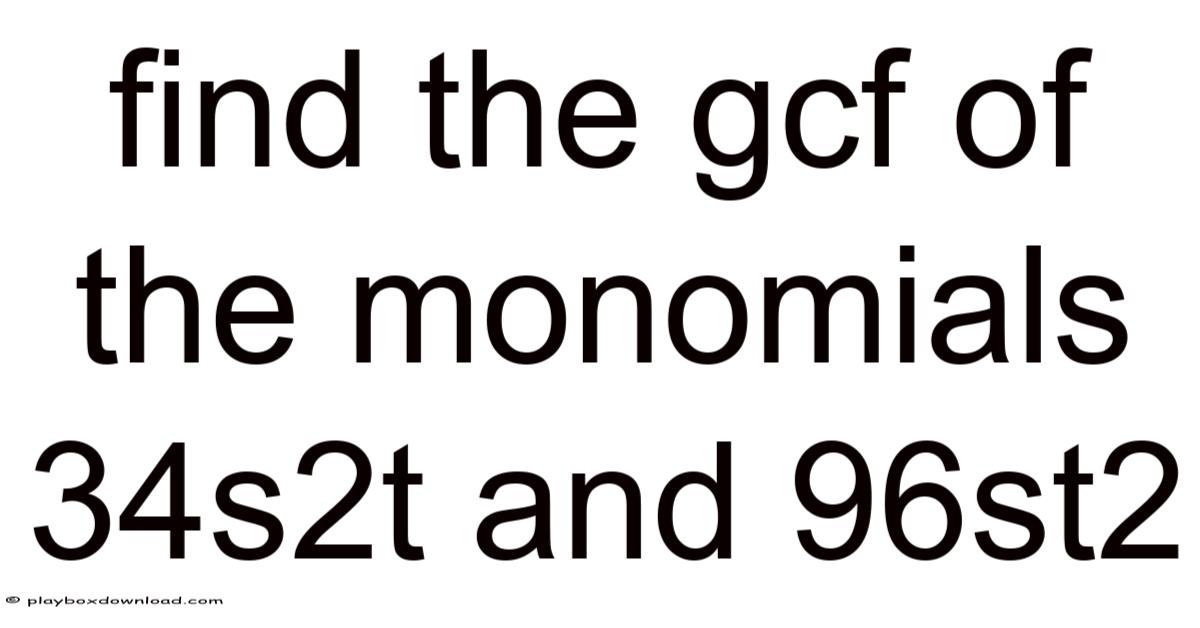
The complex dance of mathematics unfolds in the quiet realm of algebraic structures, where precision and elegance converge to reveal truths that transcend mere calculation. Such an analysis serves as a gateway to understanding broader applications within mathematics, from simplifying expressions in engineering and computer science to enriching the theoretical framework that sustains mathematical problem-solving itself. Worth adding: the journey begins with recognizing the components that define each monomial: the coefficients, the variables raised to specific powers, and how these elements interact when seeking a common divisor. Each variable, in this case s and t, makes a difference, their respective exponents dictating the degree of commonality between the two terms. In this context, the task at hand becomes not merely a numerical exercise but an exploration into the foundational principles that underpin mathematical coherence. To find their GCD, one must dissect these elements individually and collectively, ensuring that no detail is overlooked. Among these disciplines, the concept of greatest common divisor (GCD), often introduced in elementary mathematics as a tool for simplifying fractions or solving equations, finds unexpected depth when applied to the realm of polynomial algebra. Worth adding: the monomial 34s²t contains a coefficient of 34 paired with s squared and t to the first power, while the second term, 96st², presents a coefficient of 96, s to the first power, and t squared. Here, we get into the specific challenge of determining the greatest common divisor of two monomials—34s²t and 96st²—thereby illuminating how abstract algebraic concepts manifest in tangible calculations. This process demands careful attention to the interplay between numerical coefficients and variable exponents, revealing that the GCD here is not just a numerical value but a profound reflection on the shared foundations that bind these terms together. The process involves breaking down each component into its constituent parts, examining their multiplicative relationships, and identifying the minimal exponents that apply universally across both expressions.
reasoning. To execute this task with precision, one must first decouple the numerical coefficients from the variable components. Considering the numbers 34 and 96, their prime factorizations are 2 × 17 and 2⁵ × 3, respectively. The intersection of these sets of prime factors yields 2, establishing the numerical component of the GCD Simple, but easy to overlook..
Regarding the variable (s), the exponents 2 and 1 dictate that the smallest power common to both monomials is (s^{1}). Moving on to the second variable, (t) appears with exponents 1 and 2 in the two terms; consequently the minimal exponent shared is (t^{1}).
Putting the pieces together, the greatest common divisor of the two monomials is obtained by multiplying the common numerical factor with the common variable factors raised to their minimal exponents. Thus
[ \gcd(34s^{2}t,;96st^{2}) = 2 \cdot s^{1} \cdot t^{1}=2st. ]
This result is more than a mechanical outcome; it illustrates how the notion of “greatest commonality” operates across disparate algebraic structures. And in broader algebraic contexts, the same principle extends to polynomials, where the GCD of two expressions is the highest‑degree polynomial that divides each term without remainder. The monomial GCD we have just derived serves as a building block for such generalizations, reinforcing the idea that commonality can be quantified precisely when one respects both coefficient and exponent constraints Turns out it matters..
The significance of this exercise reverberates across numerous mathematical and applied domains. Because of that, engineers designing control systems, for instance, often simplify rational transfer functions by canceling common factors; recognizing that a monomial such as (2st) can be factored out streamlines the analysis and enhances numerical stability. In computational algebra systems, algorithms for polynomial GCD computation rely on the same foundational steps—factorization, exponent reduction, and multiplication of common components—that we applied here. Likewise, in coding theory, the extraction of shared factors from codewords enables error‑correction schemes to operate more efficiently, directly leveraging the insight that a compact common divisor exists.
Beyond practical applications, the GCD of monomials embodies a philosophical lesson about unity and reduction in mathematics. By distilling two seemingly distinct expressions to a single, simplest shared element, we uncover an underlying order that ties disparate parts of a mathematical universe together. This notion of reduction—finding the most essential shared component—mirrors broader mathematical strategies, from simplifying fractions to decomposing complex structures into irreducible constituents That alone is useful..
At the end of the day, the process of determining the greatest common divisor of (34s^{2}t) and (96st^{2}) is a microcosm of algebraic reasoning. On top of that, it showcases how systematic factor analysis, combined with an awareness of both numerical and variable contributions, yields a concise and meaningful result: (2st). This single monomial not only serves as a concrete answer but also as a gateway to deeper concepts that permeate various branches of mathematics and its applications. By mastering such elementary yet profound calculations, we equip ourselves with the tools necessary to figure out more detailed algebraic landscapes, underscoring the enduring relevance of GCD as a bridge between elementary arithmetic and advanced algebraic theory Simple, but easy to overlook. Worth knowing..
Building on the elementaryexample, the same principle finds expression in more sophisticated settings where multiple variables intertwine. Practically speaking, in the ring of multivariate polynomials, the greatest common divisor is defined up to multiplication by a unit, and one typically extracts a content‑free part after removing any integer factor that is common to all coefficients. This two‑stage approach—separating the numeric content from the variable‑based part—mirrors the step we performed with the monomials, where the coefficient 2 and the variable product (st) were identified as the shared elements. When the polynomials involve higher-degree terms, algorithms such as subresultant PRS or modular GCD computation systematically apply Euclidean‑type divisions while preserving this separation, ensuring that the final divisor is both coefficient‑minimal and exponent‑optimal.
The utility of this notion extends far beyond textbook exercises. Practically speaking, in computer‑aided design of digital filters, rational functions are routinely reduced by cancelling common polynomial factors; the resulting simpler transfer function not only clarifies the underlying pole‑zero structure but also improves numerical conditioning. Worth adding: in cryptographic protocols based on elliptic curves, the computation of shared scalar multiples often reduces to a GCD‑like operation in the underlying finite field, where recognizing a common divisor can mean the difference between a secure handshake and a vulnerable exchange. Even in data‑driven fields such as machine learning, feature selection algorithms sometimes treat each feature as a monomial in a high‑dimensional space, and the task of identifying the most parsimonious subset that explains the greatest variance parallels the extraction of a greatest common divisor Easy to understand, harder to ignore..
As a result, the act of distilling two expressions to their most essential shared component illustrates a universal mathematical rhythm: identify commonality, isolate it, and thereby simplify the surrounding structure. And this rhythmic reduction is a cornerstone of algebraic reasoning, linking elementary arithmetic to sophisticated theories such as ideal theory, Gröbner bases, and computational complexity. By mastering the basic GCD of monomials, we acquire a portable tool that recurs in diverse contexts, reinforcing the view that the deepest insights often arise from the simplest, most transparent operations Worth keeping that in mind..
This simplicity, however, belies the profound structural role that the greatest common divisor plays in unifying disparate mathematical domains. On the flip side, the Euclidean algorithm, which underlies the computation of the GCD, becomes the defining property of Euclidean domains, where the notion of “division with remainder” can be generalized to non‑numeric settings. Because of that, in abstract algebra, the existence of a GCD in a ring—such as the integers or polynomial rings over a field—characterizes a principal ideal domain (PID). The humble monomial GCD thus prefigures the deeper classification of rings according to their divisibility properties, revealing that the same algorithmic heartbeat that reduces a fraction also underpins the structure of ideals and the theory of factorization Most people skip this — try not to..
Even in fields seemingly far removed from pure arithmetic, the GCD serves as a conceptual anchor. In number theory, the extended Euclidean algorithm yields Bézout’s identity, which in turn is the foundation for solving linear Diophantine equations, modular inverses, and the Chinese remainder theorem—all tools that modern cryptography depends on. Now, in algebraic geometry, the GCD of polynomials corresponds to the intersection of algebraic curves, where common factors represent shared geometric loci. And in symbolic computation, the ability to efficiently compute the GCD allows computer algebra systems to simplify expressions, detect algebraic dependencies, and solve polynomial systems, thereby enabling everything from robotic motion planning to automated theorem proving That's the part that actually makes a difference..
What unifies these diverse applications is the recognition that the greatest common divisor is not merely a mechanical operation but a lens through which hidden symmetries and relationships are revealed. When we strip away extraneous factors and isolate the core element common to two objects, we are performing an act of mathematical reduction that mirrors the scientific method itself: find what is shared, discard what is irrelevant, and so arrive at a simpler, more fundamental truth.
So, to summarize, the greatest common divisor of monomials is far more than a preliminary exercise; it is a microcosm of algebraic thinking. By learning to identify the minimal overlapping structure between two expressions, we internalize a habit of mind that scales from the arithmetic of whole numbers to the detailed machinery of modern algebra. This enduring relevance—from elementary classrooms to the frontiers of research—affirms that the simplest operations often carry the deepest lessons, and that the GCD will remain a vital bridge connecting the concrete and the abstract for generations to come Not complicated — just consistent..
