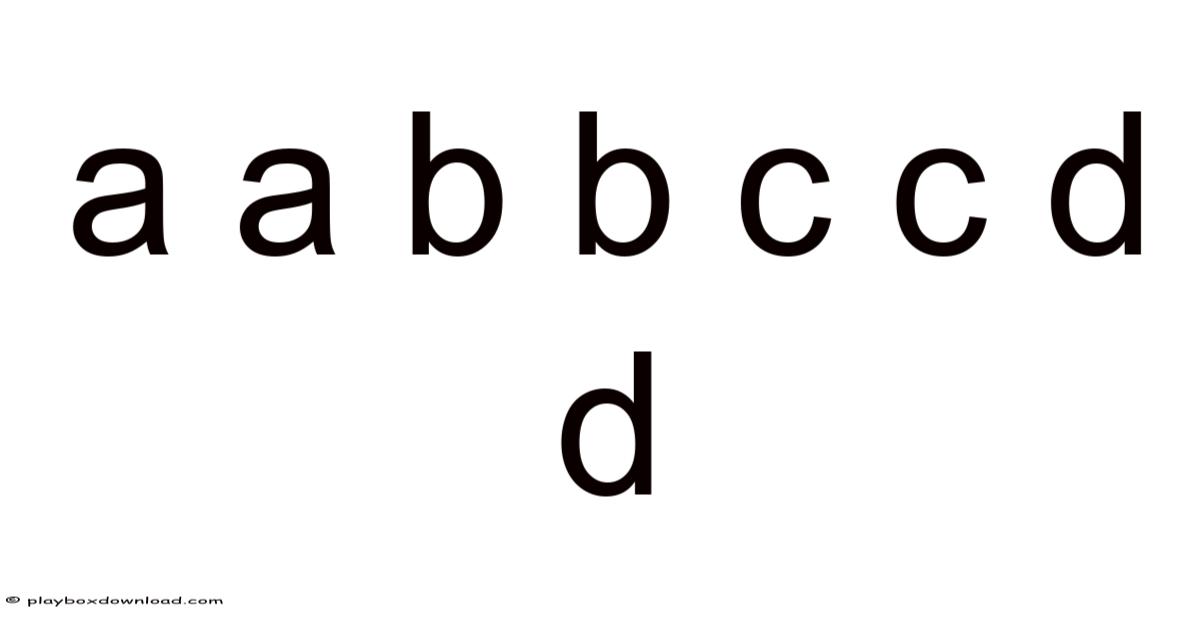
Understanding the Pattern: The Logic and Application of A A B B C C D D
The sequence A A B B C C D D may look like a simple string of letters at first glance, but it represents a fundamental concept of pattern recognition, symmetry, and structural organization. Whether it is applied in music composition, poetic structures, mathematical sequences, or basic childhood education, this specific repetition pattern serves as a building block for understanding how we organize information. Recognizing patterns is a core cognitive skill that allows humans to predict outcomes, create harmony, and categorize the world around them Simple, but easy to overlook..
Not the most exciting part, but easily the most useful.
Introduction to Pattern Recognition
At its heart, the A A B B C C D D sequence is a form of repetitive pairing. When we see "A" followed by another "A," our brain registers a duplication. Practically speaking, in the world of cognitive psychology, pattern recognition is the process by which the brain identifies a regularity in a series of stimuli. When that is followed by "B B," the brain recognizes a recurring rule: "Every element must be paired with its identical twin Worth knowing..
This specific structure is often used as an introductory tool for students learning logic and sequencing. That's why it teaches the concept of consistency. So if a child can identify that the pattern is based on pairs, they can predict that if the sequence continues, the next element will be "E E. " This ability to extrapolate is the foundation of algebraic thinking and scientific hypothesis testing.
Applications in Music and Rhythm
In the realm of music theory, the A A B B C C D D structure is frequently used to create a sense of balance and resolution. Music is essentially a series of patterns—repetitions and variations that create emotional responses.
The Concept of Repetition and Contrast
When a composer uses an A A structure, they are establishing a "theme." The first 'A' introduces the melody, and the second 'A' reinforces it, ensuring the listener remembers the motif. When the music shifts to B B, it introduces a contrast. This shift prevents the music from becoming monotonous while still maintaining a sense of order And it works..
- A A: The Statement (Introduction of the theme)
- B B: The Response (A contrasting but balanced shift)
- C C: The Development (Further exploration of the mood)
- D D: The Resolution (Bringing the sequence to a satisfying close)
This rhythmic pairing is common in folk songs and nursery rhymes, where the repetition helps the listener anticipate the next beat, making the music more catchy and memorable.
The Role of A A B B C C D D in Poetry and Literature
In literature, specifically in poetry, this pattern is known as a rhyme scheme. While most famous poems use patterns like A B A B (alternate rhyme) or A A B B (rhyming couplets), the extended A A B B C C D D structure represents a series of consecutive couplets Still holds up..
The Power of the Couplet
A couplet consists of two lines of verse that rhyme and usually have the same meter. When a poem follows an A A B B C C D D scheme, it creates a driving, rhythmic pace. This structure is often used in:
- Narrative Poetry: To tell a story quickly and clearly.
- Children's Verse: To make the poem easy to memorize.
- Didactic Poetry: To convey a moral lesson where each pair of lines delivers a complete thought.
The psychological effect of this pattern is a feeling of completion. Because every line finds its "match" immediately, the reader feels a sense of stability and closure at the end of every second line.
Mathematical and Logical Perspectives
From a mathematical standpoint, the A A B B C C D D sequence is a study in symmetry and grouping. In discrete mathematics and computer science, this can be viewed as a set of paired data points.
Algorithmic Thinking
In programming, identifying such patterns is crucial for writing efficient code. If an algorithm can detect that a data stream follows a paired pattern, it can optimize how it processes that information. As an example, instead of processing eight individual items, the system can process four pairs. This is the basis of data compression, where redundant information (the second 'A' in 'A A') is identified to save space.
Logical Sequencing
In logic puzzles, this sequence is often used to test a person's ability to identify a rule. The rule here is: n = 2x. Every single element must appear exactly twice. If a sequence were to appear as A A B B C D D, a logical mind would immediately flag the "C" as an anomaly or an "error" because it breaks the established rule of pairing.
Educational Importance in Early Childhood Development
For young learners, the A A B B C C D D pattern is a vital stepping stone in the development of pre-algebraic skills. Before a child can understand $2x + 2 = 6$, they must first understand the concept of "two of a kind."
How it Helps Learning
- Visual Discrimination: Children learn to distinguish between different shapes or colors (e.g., Red Red, Blue Blue, Green Green, Yellow Yellow).
- Predictive Reasoning: By asking "What comes next?", educators encourage children to use evidence from the existing sequence to make a logical guess.
- Fine Motor Skills: Using blocks or beads to recreate the A A B B C C D D pattern helps synchronize hand-eye coordination with cognitive planning.
Scientific Explanation: Why Our Brains Love Patterns
Human beings are biologically wired to seek patterns. Practically speaking, this is known as apophenia in its extreme form, but in a healthy capacity, it is a survival mechanism. Our ancestors survived by recognizing patterns in nature—the migration of birds, the changing of seasons, or the tracks of a predator Practical, not theoretical..
The A A B B C C D D pattern is satisfying to the human brain because it minimizes "cognitive load." When the brain recognizes a pattern, it no longer has to work hard to figure out what is happening; it can simply "ride the wave" of the expectation. This release of tension when the second 'A' follows the first 'A' triggers a small reward response in the brain, which is why we find symmetry and repetition aesthetically pleasing.
FAQ: Frequently Asked Questions
Q: Is A A B B C C D D the same as a mirror pattern? A: No. A mirror pattern would be A B C D D C B A. The A A B B C C D D pattern is a repetitive sequence, whereas a mirror pattern is a palindromic sequence.
Q: Where can I apply this pattern in daily life? A: You can use it in organization. To give you an idea, when organizing a wardrobe or a bookshelf, pairing similar items together (two books of the same genre, two shirts of the same color) creates a visual order that mimics this pattern.
Q: Why is this pattern easier to remember than A B C D A B C D? A: Because the "chunking" is smaller. In A A B B, the brain only has to remember one piece of information before it is reinforced. In A B C D, the brain must hold four different pieces of information in its short-term memory before the pattern repeats.
Conclusion: The Beauty of Simple Order
While A A B B C C D D may seem like a trivial string of characters, it is a window into how we perceive the world. From the rhythmic beats of a song to the structured lines of a poem and the logical flows of a computer program, the power of the pair is omnipresent.
By understanding and applying this pattern, we learn the importance of consistency, balance, and predictability. Whether you are a student learning the basics of logic, a musician composing a melody, or a programmer optimizing a system, recognizing the symmetry of paired sequences allows for greater clarity and efficiency. Order is the antidote to chaos, and the simple repetition of A A B B C C D D is one of the most basic and satisfying forms of order we encounter Practical, not theoretical..
