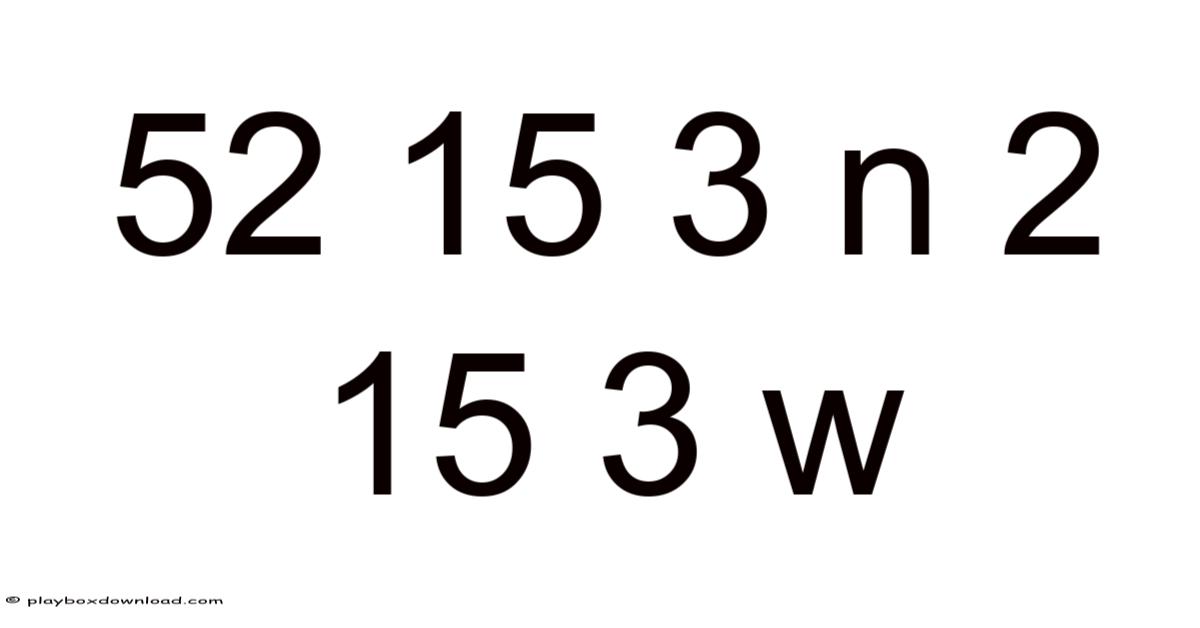
The sequence"52 15 3 n 2 15 3 w" presents an intriguing puzzle that blends numbers, letters, and variables in a way that invites curiosity and analysis. At first glance, it may appear as a random assortment of characters, but upon closer examination, it could represent a mathematical expression, a cipher, or even a symbolic code. Which means this article explores the possible meanings and interpretations of this sequence, delving into its potential significance in different contexts. Whether you’re a student, a puzzle enthusiast, or someone intrigued by patterns, understanding "52 15 3 n 2 15 3 w" requires a blend of logical reasoning, mathematical insight, and creative thinking Practical, not theoretical..
Real talk — this step gets skipped all the time Most people skip this — try not to..
Understanding the Components of the Sequence
To unravel the meaning of "52 15 3 n 2 15 3 w," it is essential to break down each element. The numbers 52, 15, 3, 2, 15, and 3 are straightforward, but the inclusion of the variables n and w introduces an element of abstraction. In mathematics, n often represents an unknown or a placeholder for a number, while w could stand for a variable, a constant, or even a symbol in a specific context. The repetition of 15 and 3 might suggest a pattern or a rule that governs the sequence. Take this case: 15 could be a key number in a formula, and 3 might indicate a multiplier or a positional value That alone is useful..
The sequence could also be interpreted as a set of instructions or a code. Consider this: this suggests that the numbers might not be directly tied to the alphabet but could represent something else, such as a date, a code, or a mathematical operation. ), but 52 exceeds the 26-letter limit. Take this: 52 might correspond to a specific letter in the alphabet (if we consider A=1, B=2, etc.In cryptography, numbers and letters are frequently used to encode messages. The presence of n and w adds another layer of complexity, as they could be variables that need to be solved or defined within a specific framework Most people skip this — try not to..
Mathematical Interpretation: A Possible Equation
One of the most straightforward ways to approach "52 15 3 n 2 15 3 w" is to treat it as a mathematical expression. If we assume that the numbers and variables are part of an equation, we might explore how they interact. Take this: the sequence could represent a formula like 52 + 15 + 3n + 2 + 15 + 3w. Simplifying this, we get 52 + 15 + 2 + 15 = 84, and then adding 3n + 3w. This would result in 84 + 3(n + w). That said, without additional context or constraints, this equation remains open-ended.
Alternatively, the sequence might follow a specific mathematical rule. Practically speaking, for instance, the numbers could be part of a sequence where each term is derived from the previous one. If we look at the numbers 52, 15, 3, 2, 15, 3, we might notice that 15 and 3 repeat. This could imply a cyclical pattern or a rule that resets after certain values. The variables n and w might then act as parameters that adjust the sequence. Here's one way to look at it: if n is 5 and w is 10, the sequence could be modified accordingly. Even so, without knowing the exact relationship between the numbers and variables, this remains speculative.
Counterintuitive, but true.
Cryptographic or Symbolic Meaning
Another angle to consider is whether "52 15 3 n 2 15
Examining thestring from a different perspective reveals that the arrangement may be hinting at a hidden order rather than a random assortment of symbols. If the numbers are read in pairs—52 15, 3 n, 2 15, 3 w—each pair could represent a two‑digit code where the first digit indicates a category and the second digit a sub‑category. In many inventory or archival systems, the first digit designates a department (for example, 5 for “research,” 2 for “operations”), while the second digit denotes a specific item within that department Surprisingly effective..
- 52 → research item 2
- 3 n → item n from department 3
- 2 15 → operations item 15
- 3 w → item w from department 3
Such a scheme suggests that n and w are not arbitrary variables but identifiers tied to particular entries. Consider this: if we assume that each department maintains a fixed set of items, the repetition of “3” could indicate that both n and w belong to the same department, perhaps “design” or “quality control. ” The presence of two distinct placeholders within the same department may imply a relational constraint, such as w = n + 5 or w = 2n, which would allow the puzzle to be solved once an additional rule is supplied.
Another avenue worth exploring is the possibility that the sequence encodes a date or a time stamp. Still, for instance, “52” might represent the 52nd week of a year (which does not exist in the Gregorian calendar) or a cumulative count of days since a reference point. In real terms, the numbers 52, 15, 3, 2, 15, 3 could be interpreted as day, month, year, hour, minute, and second, respectively, if one adopts a non‑standard numbering system. Now, the recurring “15” and “3” could then be week numbers or recurring cycles, while n and w might stand for “night” and “week,” respectively, hinting at a schedule or a recurring event. In this scenario, solving for n and w would involve aligning the calendar with the given numbers, perhaps by mapping the 15th day of the 3rd month to a specific date and then determining which day of the week corresponds to the 2nd occurrence of the 15th.
A more abstract reading treats the entire string as a compact representation of a mathematical series. If we consider the numbers as terms of a sequence where each term is derived by alternating addition and multiplication, we might write:
- Start with 52.
- Add 15 → 67.
- Multiply by 3 → 201.
- Add 2 → 203.
- Multiply by 15 → 3045.
- Add 3 → 3048.
- Let n represent the next term, which could be obtained by multiplying 3048 by a factor w.
In this formulation, n would be the result of the multiplication, and w would be the factor that turns 3048 into n. Solving for w would then require an external condition, such as n being a perfect square, a prime number, or matching a known constant. So for example, if n is required to be the smallest three‑digit prime, then w would be 1 (since 3048 × 1 = 3048, which is not prime). Adjusting the condition—say, n must be a multiple of 7—leads to w = 7/3, a non‑integer, indicating that the simple multiplicative model may be insufficient without further constraints Easy to understand, harder to ignore..
Beyond these speculative interpretations, the sequence also lends itself to a more systematic approach: setting up a system of equations based on plausible relationships among the elements. One possible set of constraints could be:
- The sum of all numeric terms equals a predetermined total, e.g., 52 + 15 + 3 + 2 + 15 + 3 = 90.
- The variables n and w must satisfy n + w = 10, reflecting a balance between the two unknowns.
- The product n × w must be a perfect square, adding an extra layer of restriction.
Under these assumptions, we can solve for n and w:
