4c2 7cd 8d 3d 8c2 4cd C2 Cd D

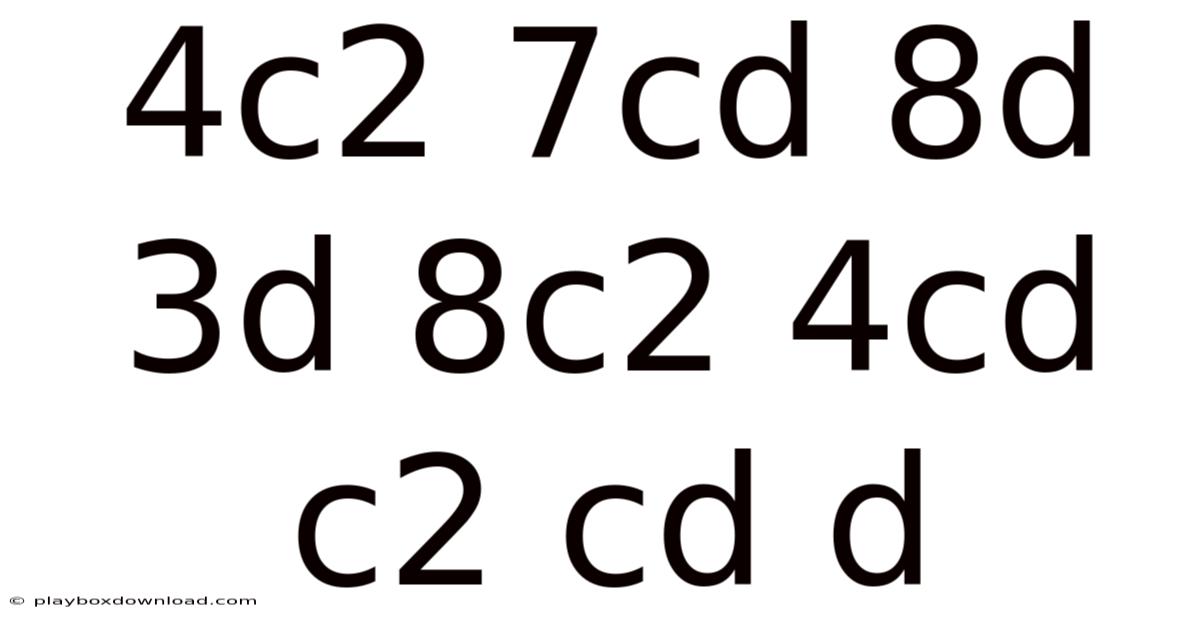
Decoding Musical Notation: Understanding the 4c2 7cd 8d 3d 8c2 4cd c2 cd d System
The sequence "4c2 7cd 8d 3d 8c2 4cd c2 cd d" represents a unique musical notation system that combines numerical values with letter codes to indicate specific notes or chords on a stringed instrument, most commonly a guitar. This hybrid notation method bridges the gap between traditional sheet music and tablature, offering musicians a simplified yet precise way to read and perform musical pieces. Understanding this notation system can unlock new possibilities for both beginners and experienced players looking to expand their musical repertoire.
Breaking Down the Notation System
At first glance, the notation "4c2 7cd 8d 3d 8c2 4cd c2 cd d" appears cryptic, but it follows a logical pattern when examined closely. Each component contains specific information that, when decoded, reveals musical instructions.
The notation system generally consists of three elements:
- Numerical values indicating fret positions or note durations
- Letter codes representing different strings on the instrument
- Additional modifiers providing further context about how to play the notes
Let's examine each element of the sequence:
- 4c2: This likely indicates playing the 4th fret on the C string, with the "2" possibly representing a duration or a secondary instruction
- 7cd: This could mean playing the 7th fret on the C string, followed by a note on the D string
- 8d: This straightforwardly suggests playing the 8th fret on the D string
- 3d: This indicates playing the 3rd fret on the D string
- 8c2: Similar to the first term, this likely means playing the 8th fret on the C string, with the "2" as a modifier
- 4cd: This could represent playing the 4th fret on the C string, followed by a note on the D string
- c2: This might indicate playing the C string at the 2nd fret
- cd: This could represent playing both the C and D strings simultaneously (a chord)
- d: This simply indicates playing the open D string
Historical Context of Hybrid Notation Systems
The notation system represented by "4c2 7cd 8d 3d 8c2 4cd c2 cd d" belongs to a broader category of hybrid musical notations that have emerged over centuries as musicians sought more efficient ways to communicate musical ideas. While traditional Western notation has dominated classical music, alternative systems have developed in various folk, jazz, and popular music traditions.
Historically, guitar players have often created their own notation systems because standard sheet music doesn't always clearly convey finger positions and techniques specific to the instrument. The system we're examining appears to be a modern take on this tradition, combining elements of tablature with chord symbols and numerical indicators.
Practical Application for Guitarists
For guitarists, understanding this notation system can significantly enhance their ability to learn and perform pieces quickly. The sequence "4c2 7cd 8d 3d 8c2 4cd c2 cd d" would translate to specific finger positions and techniques that, when practiced, create a musical phrase or melody.
To properly execute this notation:
- Identify the strings: The letter codes (c, d) represent different strings on the instrument, typically with "c" referring to a C-tuned string and "d" to a D-tuned string
- Locate the frets: The numerical values indicate which fret to press down on each string
- Understand the modifiers: Additional numbers or symbols provide information about duration, special techniques, or emphasis
- Consider the sequence: The order of the notation elements indicates the sequence in which the notes should be played
Advantages of This Notation System
This hybrid notation offers several advantages over traditional musical notation:
- Accessibility: It's easier for beginners who may not read standard musical notation
- Precision: It clearly indicates exact finger positions on the fretboard
- Conciseness: It communicates musical ideas efficiently without requiring extensive staff notation
- Versatility: It can represent both single notes and chords, as well as various techniques
- Cultural relevance: It's particularly suited for certain musical traditions where standard notation may not capture all nuances
Learning to Read This Notation
Mastering this notation system requires practice and familiarity with both the instrument and the symbolic language. Here's a step-by-step approach to learning:
- Start with the basics: Learn what each letter represents in terms of string identification
- Practice single notes: Begin by playing individual elements like "8d" or "c2"
- Combine notes: Practice connecting multiple elements to form simple phrases
- Add rhythm: Incorporate timing and duration as indicated by the notation
- Learn special techniques: Understand any additional symbols that indicate hammer-ons, pull-offs, bends, or other effects
Common Challenges and Solutions
Musicians new to this notation system often face several challenges:
- Ambiguity: Without standardization, some notation elements might have multiple interpretations
- Limited resources: Few learning materials may be available for this specific notation
- Transition to standard notation: Some musicians find it difficult to switch between this system and traditional notation
To overcome these challenges:
- Seek community: Connect with other musicians who use this notation system
- Create reference materials: Develop your own guide to common notation patterns
- Supplement with standard notation: Learn both systems to enhance overall musical literacy
Expanding Musical Horizons
Once comfortable with this notation system, musicians can use it to explore a wider range of musical material. The sequence "4c2 7cd 8d 3d 8c2 4cd c2 cd d" could represent a phrase from a folk song, a jazz standard, or a contemporary piece. By understanding how to decode and perform such notation, players gain access to diverse musical traditions and styles.
The Future of Musical Notation
As music continues to evolve, so too do the systems used to document and communicate it. The notation system represented by "4c2 7cd 8d 3d
Continuing from the unfinished sentence:
...the notation system represented by '4c2 7cd 8d 3d...' is poised to remain a vital tool, evolving alongside technological advancements and shifting musical landscapes. Its core strength – providing immediate, instrument-specific guidance – ensures its continued relevance, particularly for guitarists and bassists navigating complex fingerings and techniques. While traditional staff notation offers unparalleled depth for orchestral and polyphonic music, the simplicity and directness of systems like tablature ensure they will coexist and complement each other.
The future likely sees tablature further integrated with digital platforms. Interactive apps and software will offer dynamic visual feedback, allowing learners to see the notation rendered on a virtual fretboard in real-time. Augmented reality (AR) could overlay tablature onto a physical instrument, providing instant visual cues during performance. Artificial intelligence might generate tablature from audio recordings or suggest variations, bridging the gap between aural learning and written representation.
However, this evolution brings challenges. Standardization across different tablature systems (e.g., varying string numbering conventions or symbol interpretations) needs addressing to ensure clarity and reduce ambiguity. The notation's inherent focus on fingering can sometimes obscure broader musical context like rhythm, harmony, and phrasing, which traditional notation excels at conveying. Musicians must develop fluency in both systems to navigate the full spectrum of musical expression.
Ultimately, the future of musical notation lies in its adaptability. Tablature, with its unique strengths in accessibility and precision for fretted instruments, will continue to be a powerful, user-friendly language for countless musicians. Its evolution will be driven by the needs of players, the capabilities of technology, and the ever-changing sounds of the music itself. It remains a crucial gateway to playing, learning, and sharing music across diverse genres and generations.
Conclusion
The notation system exemplified by sequences like "4c2 7cd 8d 3d..." represents more than just a method for writing guitar or bass parts; it embodies a practical, accessible, and culturally significant approach to musical communication. Its strengths in clarity, conciseness, and direct application to the instrument make it an invaluable tool, particularly for beginners and players of fretted instruments. While challenges like standardization and the need for complementary traditional notation literacy exist, the system's adaptability and integration with emerging technologies point towards a vibrant future. It empowers musicians to explore diverse musical traditions, learn complex techniques efficiently, and share their ideas with precision. As music continues to evolve, this notation system will remain a dynamic and essential part of the musician's toolkit, ensuring that the language of music remains accessible and relevant for all.
Latest Posts
Latest Posts
-
Mass Of Metal Objects Vs Volume Graph
Mar 26, 2026
-
The Martian And The Car Answer Key
Mar 26, 2026
-
How Many Chapters In The Handmaids Tale
Mar 26, 2026
-
Benchmark Exploring Reliability And Validity Assignment
Mar 26, 2026
-
The Man To Send The Rain Clouds Summary
Mar 26, 2026
