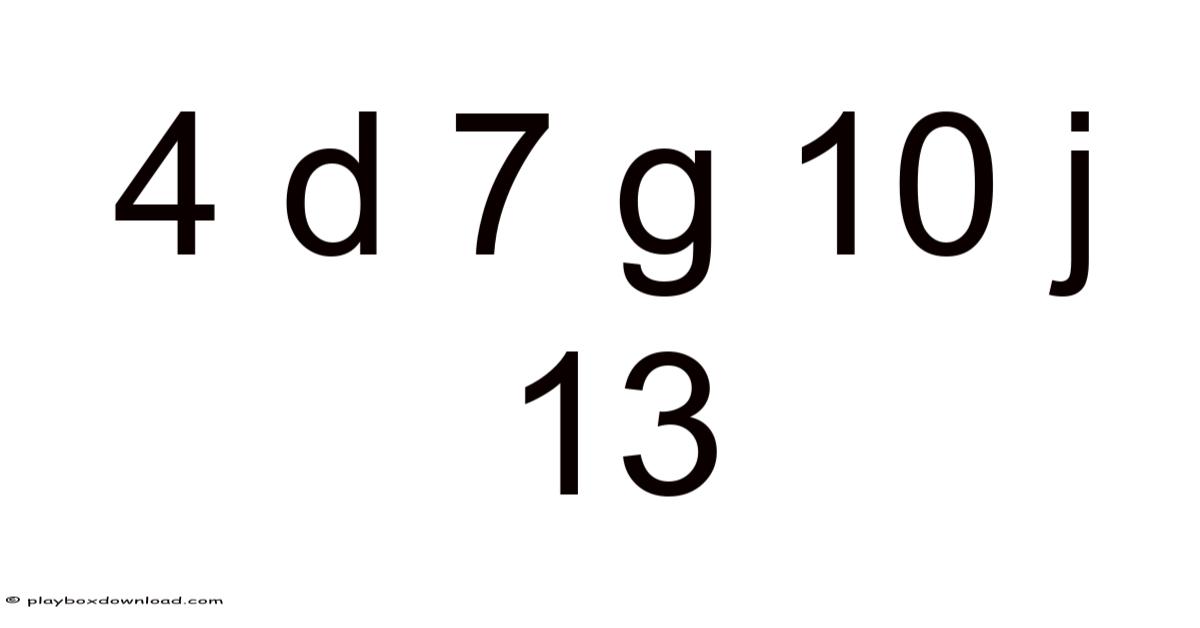
Understanding the 4 d 7 g 10 j 13 Pattern: A Deep Dive into Alphabetic Sequences
The sequence 4 d 7 g 10 j 13 appears simple at first glance, but it conceals a fascinating relationship between numbers and letters that teaches fundamental concepts in pattern recognition, arithmetic progression, and alphabetic mapping. On top of that, this pattern is often used in puzzles, coding challenges, and educational exercises to sharpen logical thinking. In this article, we will explore the mechanics behind the sequence, its variations, real-world applications, and why it remains a popular tool for learning.
The Pattern Explained
At its core, the sequence 4 d 7 g 10 j 13 follows a dual progression: the numbers increase by a constant step of 3, and the corresponding letters move forward by three positions in the English alphabet. Let’s break it down:
- The number 4 corresponds to the 4th letter of the alphabet: D.
- Adding 3 gives 7, which maps to the 7th letter: G.
- Adding another 3 gives 10, mapping to J.
- Finally, 13 corresponds to M.
So the complete sequence should logically be 4 d 7 g 10 j 13 m. The original title "4 d 7 g 10 j 13" either omitted the last letter for brevity or presented a partial puzzle. The underlying rule is a simple arithmetic sequence with a step of 3, applied to both the numeric value and the alphabetic position. This creates a linear pattern that is easy to extend indefinitely: 16 p, 19 s, 22 v, 25 y, and so on The details matter here. That's the whole idea..
Why 3? The Role of Step Size
The step size of 3 is not arbitrary. The number 3 also appears frequently in natural patterns — three primary colors, three dimensions, three-part structures in storytelling. Consider this: a step of 1 would be too simple (1 a, 2 b, 3 c), while a step of 5 might be too sparse for beginners. It is small enough to be immediately recognizable yet large enough to avoid triviality. This makes the sequence psychologically pleasing and easy to remember The details matter here..
Applications in Puzzles and Brain Teasers
The 4 d 7 g 10 j 13 pattern is a staple in logic puzzles, IQ tests, and escape room challenges. It tests a person’s ability to notice simultaneous changes in two different domains: numbers and letters. Here are some common ways it appears:
- Fill-in-the-blank sequences: “4, d, 7, g, 10, j, 13, ___” The answer is m.
- Decoding messages: If you assign numbers to letters (A=1, B=2, etc.), this pattern becomes a cipher where each term is spaced by 3. Take this case: the word “D G J M” can be decoded by multiplying positions or using a reverse mapping.
- Pattern extrapolation: Given the first four terms, a solver must predict the next three or four. This builds sequential reasoning skills used in mathematics and programming.
Real-World Puzzle Examples
In educational board games like Code Names or Mastermind, similar patterns appear as clues. Which means for example, a clue “3 letters ahead” might lead a player to associate 4 with D, 7 with G, and so on. In cryptography, this is analogous to a Caesar cipher with a fixed shift, but instead of shifting all letters uniformly, you only shift the position of selected indices And that's really what it comes down to..
Some disagree here. Fair enough Most people skip this — try not to..
Educational Value for Students
Teachers often introduce the 4 d 7 g 10 j 13 sequence to students in grades 3–6 as a bridge between arithmetic and language arts. It reinforces multiple concepts simultaneously:
1. Alphabetical Order and Numeracy
Young learners must recall the alphabet order (A=1, B=2, etc.) while performing addition. This dual-task strengthens memory and cognitive flexibility. Take this: finding the 13th letter requires counting from A to M, which is a basic skill in early literacy.
2. Arithmetic Progression
The numeric part (4, 7, 10, 13) is a classic arithmetic sequence with common difference +3. Students can practice finding the nth term using the formula:
[ a_n = a_1 + (n-1) \times d ]
Where (a_1 = 4) and (d = 3). So the 5th term is (4 + (5-1) \times 3 = 4 + 12 = 16), which corresponds to the letter P.
3. Pattern Recognition Across Modalities
This is a cross-domain pattern — it connects numbers to letters. Recognizing that the same rule applies to two different representations is a higher-order thinking skill. It prepares students for more advanced topics like functions and mappings in algebra, where one input yields an output in a different set But it adds up..
Scientific Explanation: Why Our Brains Love Such Patterns
From a cognitive science perspective, patterns like 4 d 7 g 10 j 13 activate both the left hemisphere (which processes sequential, logical information) and the right hemisphere (which handles spatial and relational thinking). The alternating number–letter structure engages the brain’s pattern recognition system, which evolved to detect predictable sequences in the environment — from the seasons to animal migration.
The Zeigarnik Effect
Incomplete patterns also trigger the Zeigarnik effect: our minds remember unfinished tasks better than completed ones. When a puzzle presents “4 d 7 g 10 j 13” without the final letter, the brain feels compelled to complete it. This is why such sequences are so effective in quizzes and educational games — they create a mild cognitive tension that drives curiosity.
Variations of the Pattern
The underlying logic can be modified to suit different difficulty levels. Here are a few common variations:
1. Different Step Sizes
- Step of 2: 2 b 4 d 6 f 8 h … (even numbers + corresponding letters)
- Step of 5: 5 e 10 j 15 o 20 t …
- Step of -3 (decreasing): 13 m 10 j 7 g 4 d …
2. Reverse Mapping (Letters to Numbers)
Instead of starting with numbers, begin with letters and ask for the numeric value: “D, G, J, M” → 4, 7, 10, 13.
3. Skipping Letters or Numbers
Some puzzles intentionally omit certain terms and ask the solver to fill them in: “4, __, 10, __, 16” with corresponding letters Most people skip this — try not to. No workaround needed..
4. Alphabet Wraparound
What happens when the numbers exceed 26? Take this: a step of 3 starting at 25 (Y) leads to 28 → 2 (B) if wrapped around (mod 26). This introduces modular arithmetic and is often used in more advanced coding exercises.
Frequently Asked Questions
Q: Is “4 d 7 g 10 j 13” the only possible representation of this pattern?
No. You could start at a different number (e.g., 3 c 6 f 9 i 12 l) or use a different step (e.g., 4 e 8 i 12 m 16 q with step 4). The choice of starting point and step size creates infinite variations.
Q: How is this pattern used in programming?
In coding challenges, this pattern tests a programmer’s ability to write loops that map integer indices to characters. Here's one way to look at it: in Python: [chr(64 + i) for i in range(4, 14, 3)] yields ['D', 'G', 'J', 'M']. It’s a simple exercise in list comprehension and ASCII values The details matter here..
Q: Are there any historical or cultural references?
Patterns of this kind appear in ancient numerology and gematria, where letters had numeric values (e.g., Greek isopsephy). Still, the modern alphabetical sequence with step 3 is primarily used in educational contexts rather than esoteric traditions.
Conclusion
The sequence 4 d 7 g 10 j 13 is far more than a random string of characters. It is a compact demonstration of linear progression, alphabet mapping, and pattern recognition — skills that are foundational to mathematics, language, and problem-solving. Whether you encounter it in a school worksheet, a brain teaser app, or an interview puzzle, understanding its underlying logic empowers you to extend it, modify it, and apply it to new contexts Turns out it matters..
Next time you see a pattern that blends numbers and letters, remember the simple rule: find the constant difference, map it to the alphabet, and watch the sequence unfold. Patterns like these remind us that order and predictability exist even in seemingly unrelated domains — a lesson that resonates far beyond the classroom.
