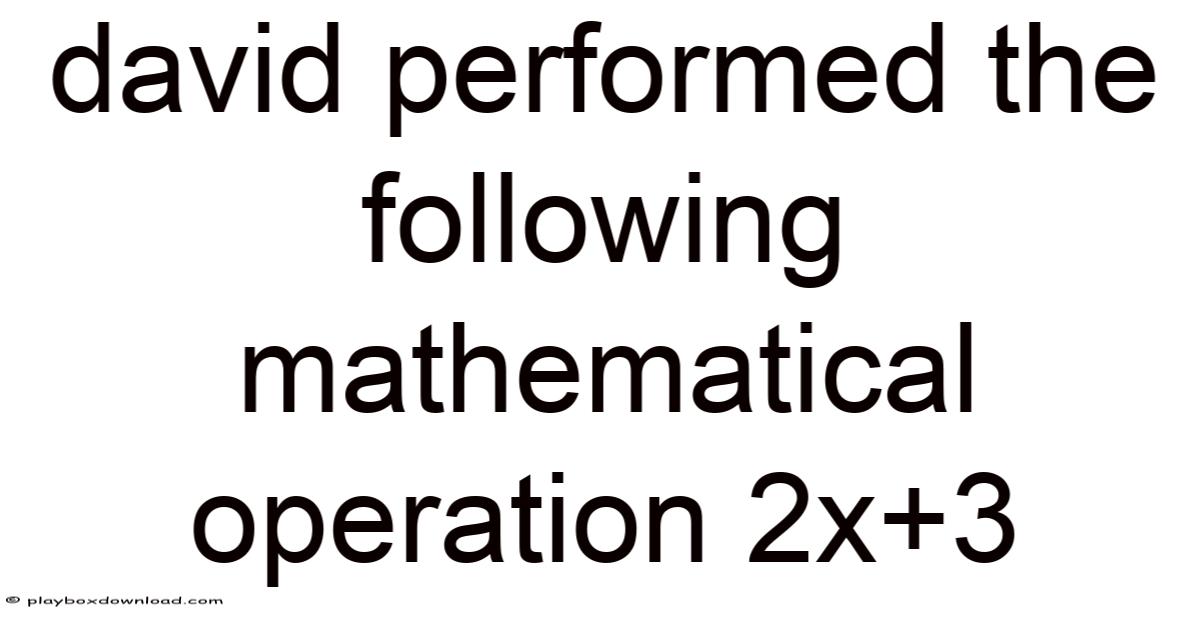
Davidperformed the following mathematical operation 2x+3, a concise algebraic expression that encapsulates the essence of linear relationships and serves as a foundational building block in algebra. This operation, though elementary, opens the door to a myriad of mathematical concepts, from solving simple equations to modeling real‑world phenomena. In the sections that follow, we will unpack each component of the expression, explore how to evaluate it, and examine its relevance across various contexts, all while maintaining a clear, engaging narrative that guides the reader from basic understanding to deeper insight.
Introduction
The phrase “David performed the following mathematical operation 2x+3” is more than a simple statement; it is an invitation to look at the world of algebra. Still, by isolating the expression 2x+3, we can discuss its structure, interpret its meaning, and apply it to solve problems. This article will walk you through the anatomy of the expression, demonstrate step‑by‑step evaluation techniques, and highlight practical applications that reinforce why mastering such basics is essential for any budding mathematician.
No fluff here — just what actually works Easy to understand, harder to ignore..
Understanding the Building Blocks
Components of the Expression - 2 – a coefficient that multiplies the variable x.
- x – the variable, representing an unknown number that can take any value.
- + – an addition operator that combines the product of the coefficient and variable with a constant. - 3 – a constant term that shifts the result upward by three units.
Together, these elements form a linear expression because the variable appears raised to the first power only. The term “linear” stems from the fact that, when graphed, the relationship produces a straight line.
Why the Order Matters
Mathematical operations follow a specific hierarchy, often remembered by the acronym PEMDAS (Parentheses, Exponents, Multiplication and Division, Addition and Subtraction). In the expression 2x+3, multiplication (the product of 2 and x) is performed before addition, ensuring that the coefficient is applied to the variable before the constant is added.
Evaluating the Expression
To evaluate 2x+3 for a specific value of x, substitute the chosen number for the variable and carry out the operations in the correct order.
- Choose a value for x – for example, x = 5.
- Multiply the coefficient by the chosen value: 2 × 5 = 10.
- Add the constant term: 10 + 3 = 13.
Thus, when x = 5, the expression 2x+3 evaluates to 13. This straightforward process can be repeated for any integer, fraction, or decimal value of x, yielding a corresponding result That's the whole idea..
Using a Table for Multiple Values
| x | 2x | 2x+3 |
|---|---|---|
| 0 | 0 | 3 |
| 1 | 2 | 5 |
| 2 | 4 | 7 |
| 3 | 6 | 9 |
| 4 | 8 | 11 |
The table illustrates how the output increases consistently as x increases, reinforcing the linear nature of the expression.
Solving for x
While evaluating an expression provides a result, solving an equation involves finding the value(s) of x that satisfy a given condition. Suppose we set the expression equal to a specific target, such as 11:
2x + 3 = 11
To isolate x, follow these steps:
- Subtract 3 from both sides: 2x = 8.
- Divide both sides by 2: x = 4.
Hence, x = 4 is the solution that makes the equation true. This method—performing inverse operations to isolate the variable—is a cornerstone of algebraic problem‑solving Turns out it matters..
General Form
If we denote the target value as k, the equation becomes:
2x + 3 = k
Solving for x yields:
x = (k − 3) / 2
This formula allows us to compute x for any chosen k quickly, demonstrating the power of algebraic manipulation.
Real‑World Applications
Budgeting and Finance
Imagine a scenario where a student saves $2 each week and also receives a one‑time bonus of $3. The total savings after w weeks can be modeled by the expression 2w + 3. By substituting different values of w, the student can predict future savings and plan accordingly It's one of those things that adds up. But it adds up..
Quick note before moving on It's one of those things that adds up..
Physics – Uniform Motion
In physics, the distance traveled by an object moving at a constant speed v over time t is given by d = vt. If the speed is 2 meters per second and there is an initial offset of 3 meters, the distance function becomes 2t + 3. This illustrates how linear expressions model real‑world motion with an initial condition.
Data Science – Linear Regression
In introductory statistics, a simple linear regression model predicts an outcome y based on a predictor x using the equation y = 2x + 3. Here, the coefficient 2 represents the slope, indicating the rate of change, while 3 is the intercept, representing the expected value of y when x = 0.
Common Mistakes and How to Avoid Them
-
Skipping the Order of Operations – Some learners may add 2 and x first, then multiply, leading to incorrect results
-
Skipping the Order of Operations – Some learners may add 2 and x first, then multiply, leading to incorrect results. Always remember PEMDAS/BODMAS: multiplication comes before addition.
-
Misapplying the Distributive Property – When working with more complex expressions like 2(x + 3), students sometimes forget to multiply both terms inside the parentheses, writing 2x + 3 instead of the correct 2x + 6 Turns out it matters..
-
Sign Errors – Negative values often cause confusion. Here's a good example: substituting x = -2 into 2x + 3 gives 2(-2) + 3 = -4 + 3 = -1, not 4 + 3 = 7. Paying close attention to signs prevents these mistakes And that's really what it comes down to..
-
Division by Zero – In the general solution x = (k - 3)/2, make sure k - 3 ≠ 0 when dealing with more complex variations, as division by zero is undefined.
Practice Problems
To reinforce understanding, try solving these exercises:
- Evaluate 2x + 3 for x = -4, 0.5, and 10.
- Solve for x when 2x + 3 = 17.
- Create a table showing x, 2x, and 2x + 3 for x = -2, -1, 0, 1, 2.
- A car rental costs $2 per mile plus a $3 flat fee. Write an expression for the total cost and calculate the cost for 15 miles.
Conclusion
The expression 2x + 3 serves as an excellent introduction to fundamental algebraic concepts, from basic evaluation to solving equations and applying mathematics to real-world scenarios. Worth adding: mastering these foundational skills builds confidence for tackling more advanced topics like quadratic equations, systems of equations, and beyond. And remember that practice and attention to detail are key—whether you're calculating savings, predicting motion, or analyzing data, the principles remain the same. By understanding how to manipulate and interpret linear expressions, you develop a versatile toolset that extends far beyond the classroom into everyday problem-solving.
These expressions exemplify the foundational role of algebra in modeling real-world phenomena, bridging abstraction with tangible outcomes. In real terms, their simplicity belies profound utility, guiding decisions in fields ranging from economics to engineering. Such clarity fosters confidence and precision, making them indispensable tools for navigating complexity. In essence, they remain a cornerstone, continually reinforcing their centrality across disciplines.
As you progress, you will discover that algebraic fluency extends far beyond the textbook, providing a universal framework for problem-solving. From deciphering patterns in data to optimizing resources, the ability to manipulate expressions like 2x + 3 equips you with the critical thinking skills necessary for innovation. In the long run, mastery of these basics is not the end of the journey but the essential beginning, ensuring that every future challenge is met with both competence and curiosity.
